

How to Prepare for an SPCB Environmental Inspection: A Complete Compliance Guide

SPCB Environmental Inspection: A Complete Compliance Guide
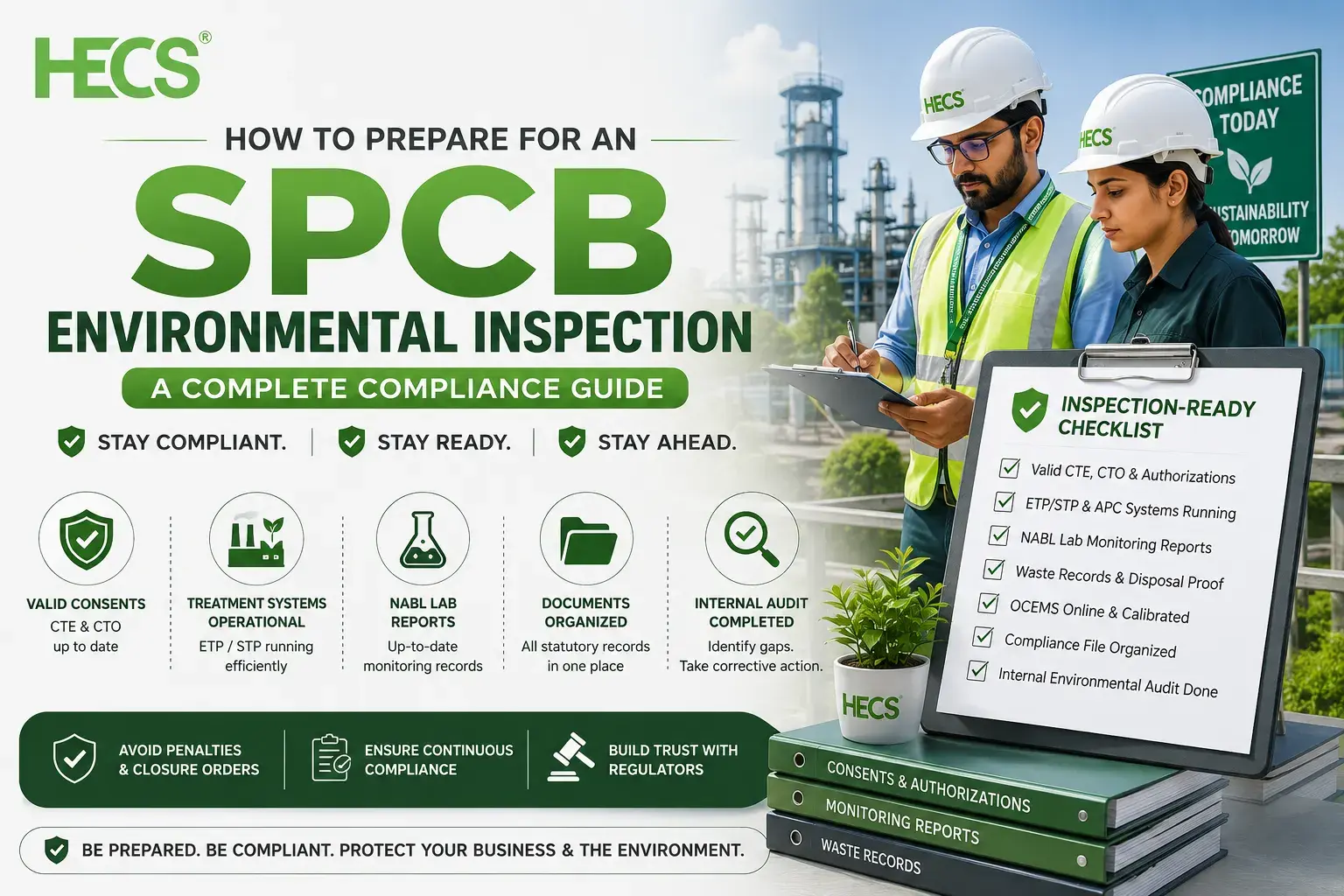
Quick answer: To prepare for a State Pollution Control Board (SPCB) environmental inspection, keep your Consent to Establish (CTE) and Consent to Operate (CTO) valid, ensure your ETP/STP and air pollution control systems are running, maintain current NABL-lab monitoring records, verify emission and effluent values against prescribed limits, organize all statutory documents in one compliance file, and run an internal environmental audit before the inspection team arrives.
An SPCB inspection can feel stressful—but for an industry that stays compliant year-round, it's simply a formality. Most notices, penalties, and closure orders don't stem from serious pollution. They stem from expired consents, missing paperwork, or a treatment plant that wasn't running the day inspectors visited. This guide walks you through exactly how to be inspection-ready, what happens on inspection day, and how to respond afterward.
What Is an SPCB Environmental Inspection?
A State Pollution Control Board inspection is a statutory check conducted under the Water (Prevention and Control of Pollution) Act, 1974, the Air (Prevention and Control of Pollution) Act, 1981, and the Environment (Protection) Act, 1986. Inspectors verify whether your facility operates within its consent conditions, whether pollution control systems function correctly, and whether hazardous and other wastes are handled and disposed of legally.
Inspections may be routine (a standard consent condition), complaint-driven, or triggered by an application for consent renewal, expansion, or a new project's environmental clearance.
Every SPCB—whether TNPCB in Tamil Nadu, MPCB in Maharashtra, GPCB in Gujarat, or KSPCB in Karnataka—follows the same central framework but applies its own inspection frequency, formats, and online systems. Always confirm your specific state board's current requirements.
Why Industries Fail SPCB Inspections
Understanding the common failure points helps you avoid them. The recurring culprits are:
Expired Consent to Operate (CTO) or Consent to Establish (CTE)
Effluent Treatment Plant (ETP) or Sewage Treatment Plant (STP) shut down, overloaded, or bypassed
Emission or effluent values exceeding prescribed discharge norms
Incomplete, backdated, or missing monitoring records
Hazardous waste stored beyond the 90-day limit or without valid authorization
No proof of authorized disposal (TSDF or registered recycler receipts)
Online monitoring systems (OCEMS) offline, disconnected, or uncalibrated
Almost every one of these is preventable with a structured routine.
Step-by-Step: How to Prepare for an SPCB Inspection
1. Verify Your Consents and Authorizations
Confirm that your CTE, CTO, Hazardous Waste Authorization, and Biomedical Waste Authorization (if applicable) are valid and displayed on-site. CTO validity typically ranges from 1 year for high-pollution "red category" units to 5 years or more for "green category" units, depending on your state board. Renewals can take several weeks to months, so apply well before expiry—operating on a lapsed consent is treated as a serious violation. (See our Consent to Operate & CTE services for renewal support.)
2. Ensure Pollution Control Systems Are Operational
Your ETP, STP, scrubbers, bag filters, and stack controls must be running and maintained—not merely installed. Keep a maintenance logbook with dates, readings, and signatures. Inspectors specifically note whether systems were functioning during the visit. (Explore our ETP/STP operation and support services.)
3. Compile Monitoring and Analysis Reports
Keep recent third-party reports for treated and untreated effluent, ambient air and stack emissions, ambient noise, and groundwater (where required). Reports from a NABL-accredited environmental laboratory carry far more evidentiary weight. (HECS operates a NABL-accredited environmental laboratory.)
4. Organize Your Waste Records
Maintain manifests, Form-10 records, and disposal receipts for hazardous, biomedical, plastic, e-waste, and general solid waste. The quantity generated should reconcile with the quantity disposed—unexplained gaps invite scrutiny.
5. Confirm Online Monitoring (OCEMS) Is Live
If your unit is directed to install Online Continuous Emission/Effluent Monitoring Systems, ensure data is transmitting to the SPCB and CPCB servers and that sensors are calibrated with valid certificates.
6. Build a Single Compliance File
Keep one indexed folder—physical and digital—containing consents, authorizations, EC conditions, monitoring reports, audit reports, and replies to previous inspections. Producing it in seconds signals a well-managed facility.
7. Conduct an Internal Environmental Audit
The most effective preparation is a mock inspection. An independent environmental audit surfaces gaps before the SPCB does, giving you time to correct them—the highest-return step you can take.
What Happens on Inspection Day
Knowing the flow removes the anxiety:
Who should be present: the occupier or an authorized signatory, plus your EHS/environmental officer. Someone must be empowered to answer and sign.
What inspectors check first: validity of consents, whether treatment systems are actively running, effluent/emission points, waste storage areas, and logbooks.
Sampling: inspectors may draw effluent, emission, or ambient samples for independent analysis—cooperate and record what was taken.
Document everything: note the officers' names, timings, observations, and any samples collected. Politely request a copy of the inspection report or observations before they leave.
Never bypass or shut systems to "look cleaner"—a stopped ETP during inspection is worse than a running one under load.
After the Inspection: Responding Correctly
If you receive observations or a show-cause notice, respond within the stipulated period (commonly 15 days, but check your notice). Submit a point-by-point compliance reply with supporting evidence—photos, revised logbooks, lab reports, and a corrective action plan with timelines. A prompt, documented response often prevents escalation to directions, bank guarantee encashment, or closure orders.
Common Mistakes to Avoid
Treating inspection as a one-day event instead of proof of year-round compliance
Assuming verbal explanations replace documented records
Ignoring the specific conditions listed inside your CTO
Missing the deadline for the post-inspection compliance reply
Stay Inspection-Ready All Year with HECS
The industries that pass SPCB inspections effortlessly treat compliance as a continuous process, not a last-minute scramble. Valid consents, working treatment systems, accurate NABL-lab reports, and organized records are your strongest defense.
Hubert Enviro Care Systems Limited (HECS) helps industries across India stay fully compliant—offering environmental consultancy, NABL-accredited laboratory testing, environmental monitoring, ETP/STP support, waste management, and complete SPCB consent and inspection support.
Facing an upcoming inspection or a compliance notice?
Share this post: