Solid Waste Management Rules, 2026: The Complete Compliance Guide for Indian Industries & Institutions
-
Home
-
Regulatory Updates
-
Solid Waste Management Rules, 2026: The Complete Compliance Guide for Indian Industries & Institutions

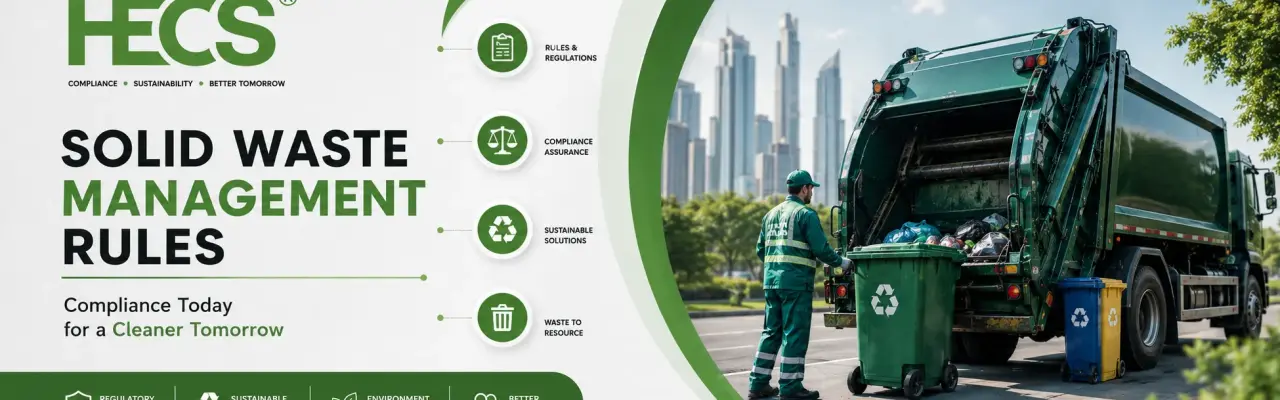


Solid Waste Management Rules, 2026
Sub-headline: India's solid waste framework has changed. Four-stream segregation at source is now mandatory, landfilling is restricted to inert residues, and every waste generator — from factories to hospitals to housing societies — carries defined legal duties. Here's everything your organisation needs to comply.
ISO-certified labs · NABL-accredited testing · 1,000+ compliance projects · Pan-India presence
QUICK ANSWER BOX What are the Solid Waste Management Rules, 2026?The Solid Waste Management (SWM) Rules, 2026, notified by the Ministry of Environment, Forest and Climate Change (MoEF&CC) under the Environment (Protection) Act, 1986, are India's updated national framework for managing municipal solid waste. They replace the Solid Waste Management Rules, 2016, and mandate four-stream segregation of waste at source — wet waste (green bin), dry waste (blue bin), sanitary waste (red bin), and special care waste (black bin) — for every waste generator, including households, industries, institutions, and commercial establishments. Wet waste must be composted or biomethanated, dry waste channelled to authorised recyclers or Material Recovery Facilities (MRFs), and only inert, non-recyclable residual waste may be sent to sanitary landfills. |
Solid Waste Management Rules, 2026 AT A GLANCE
Parameter | Detail |
Regulation | Solid Waste Management Rules, 2026 |
Notified by | Ministry of Environment, Forest & Climate Change (MoEF&CC) |
Parent Act |
|
Replaces | Solid Waste Management Rules, 2016 |
Segregation mandate | 4 streams at source: Wet · Dry · Sanitary · Special Care Waste |
Bin colour code | 🟢 Green (wet) · 🔵 Blue (dry) · 🔴 Red (sanitary) · ⚫ Black (special care) |
Applies to | All waste generators — households, industries, institutions, commercial establishments, ULBs |
Bulk Waste Generator | ~100 kg/day and above (verify notified threshold) — on-site wet-waste processing mandatory |
Wet waste rule | Composting or biomethanation; landfilling prohibited |
Landfill restriction | Inert, non-recyclable residual waste only |
Enforcement | ULBs (user fees, spot fines) + SPCBs/PCCs (consents, directions, environmental compensation) |
India's solid waste challenge in numbers: India generates roughly 1.6–1.7 lakh tonnes of municipal solid waste every day (CPCB annual reporting), of which historically only about half was scientifically processed — the gap the 2026 Rules are designed to close through universal source segregation and near-zero organic waste to landfill.
INTRODUCTION
If your organisation generates waste in India — and every organisation does — the Solid Waste Management Rules, 2026 apply to you.
Manufacturing plant, hospital campus, IT park, hotel, or residential township: the new rules redefine what you must do with every kilogram of waste you produce. How you segregate it. Where you store it. Who you hand it to. And what records you must keep to prove it.
The shift is significant. The earlier SWM Rules, 2016 required three-stream segregation. The 2026 Rules move India to a four-stream system, introduce "special care waste" as a distinct legal category, and restrict landfilling to inert residuals only. Waste generators now carry clear, enforceable duties — with monetary consequences for non-compliance.
This guide breaks down the complete framework in plain language: what the rules say, who must comply, and what a compliant system looks like on the ground — including a real quantified example from an industrial facility, plus the exact checklist and documentation your team needs.
At Hubert Enviro Care Systems (HECS), we help industries, healthcare facilities, institutions, and infrastructure projects across India design, implement, and document fully compliant solid waste management systems — from waste audits and segregation infrastructure to recycler tie-ups and regulatory filings.
WHAT ARE THE SOLID WASTE MANAGEMENT RULES?
The Solid Waste Management Rules are statutory rules issued by the Ministry of Environment, Forest and Climate Change (MoEF&CC) under the Environment (Protection) Act, 1986. They govern how municipal solid waste — the everyday waste from homes, offices, industries (non-process waste), institutions, markets, and public spaces — must be segregated, collected, stored, transported, processed, and disposed of across India.
A brief timeline:
2000 — Municipal Solid Wastes (Management and Handling) Rules: India's first dedicated MSW rules, focused mainly on municipalities.
2016 — Solid Waste Management Rules, 2016: extended duties to waste generators, introduced three-stream segregation (wet, dry, domestic hazardous), bulk waste generator obligations, and user fees.
2024 — Draft SWM Rules published by MoEF&CC for public consultation, proposing a modernised framework.
2026 — Solid Waste Management Rules, 2026 come into force, establishing four-stream segregation at source and a stricter waste-processing hierarchy.
The 2026 Rules operate alongside — not instead of — waste-stream-specific regulations: the Plastic Waste Management Rules, E-Waste (Management) Rules, Battery Waste Management Rules, Bio-Medical Waste Management Rules, C&D Waste Rules, and the Hazardous and Other Wastes (Management & Transboundary Movement) Rules, 2016.
OBJECTIVES OF THE SWM RULES, 2026
The rules are built around the waste management hierarchy — reduce → reuse → recycle → recover → dispose — and aim to:
Maximise resource recovery by making segregation at source universal and non-negotiable.
Divert organic waste from landfills through mandatory composting or biomethanation of wet waste.
Formalise recycling by channelling dry waste only through authorised recyclers and Material Recovery Facilities (MRFs).
Protect sanitation workers through secure wrapping and separate handling of sanitary waste.
Isolate hazardous household-type waste (batteries, bulbs, chemicals, expired medicines) as "special care waste" handled only by authorised agencies.
Restrict landfilling to inert, non-recyclable residual waste only — ending the practice of dumping mixed waste.
Fix accountability at every level: waste generators, local authorities, industries, and pollution control boards.
Support national programmes including the Swachh Bharat Mission and India's circular-economy and net-zero commitments.
APPLICABILITY: WHO MUST COMPLY?
The SWM Rules, 2026 apply to every waste generator in India and to every agency involved in handling municipal solid waste. In practical terms:
Waste Generators
Industries and factories (for their municipal/non-process solid waste — canteen, office, housekeeping waste)
Commercial establishments — offices, IT parks, malls, shops, markets
Institutions — schools, colleges, universities, government offices
Healthcare facilities — hospitals, clinics, labs (for general waste; biomedical waste is governed separately)
Hospitality — hotels, restaurants, caterers, banquet halls
Residential — households, apartment complexes, gated communities, townships
Transport & infrastructure hubs — airports, ports, railway stations, bus terminals
Event organisers, street vendors, and places of worship
Bulk Waste Generators (BWGs)
Establishments generating large quantities of solid waste per day (e.g., 100 kg/day or as notified) carry enhanced duties — including processing wet waste within their own premises (on-site composting or biomethanation) and formal tie-ups with authorised recyclers for dry waste. Most mid-sized and large industrial facilities, hospitals, hotels, and townships fall into this category.
Is your facility a Bulk Waste Generator? A quick benchmark: CPHEEO norms estimate waste generation at roughly 0.45 kg per person per day for institutional/industrial campuses. A facility with ~220–230 staff typically generates ~100 kg/day — right at the BWG threshold. A 450-person facility (~200+ kg/day) is unambiguously a BWG. Get a waste audit from HECS to confirm your classification.
Authorities & Operators
Urban Local Bodies (ULBs) and Panchayats
State Pollution Control Boards (SPCBs) / Pollution Control Committees (PCCs)
Operators of waste processing and disposal facilities (MRFs, compost plants, waste-to-energy plants, sanitary landfills)
Stream | Bin Colour | What Goes In | Treatment Route |
1. Wet Waste (biodegradable) | 🟢Green | Food waste, kitchen/canteen waste, vegetable & fruit peels, tea waste, garden trimmings | Composting (e.g., Organic Waste Converter) or biomethanation — landfilling prohibited |
2. Dry Waste (recyclable) | 🔵 Blue | Paper, cartons, plastics, PET bottles, glass, metal cans, rubber, textiles/rags | Authorised recyclers / Material Recovery Facility (MRF) |
3. Sanitary Waste | 🔴 Red | Used sanitary napkins, diapers, tissues, similar hygiene waste | Securely wrapped, stored separately, handed to authorised municipal collection for scientific disposal |
4. Special Care Waste | ⚫ Black | Used batteries, CFLs/LED lamps, expired medicines, paint containers, small e-waste, household chemicals | Handed over only to authorised collection centres/recyclers under the applicable rules |
Also regulated under the framework:
Inert / residual waste — sweeping dust, road dust, non-recyclable packaging residue → the only category permitted at sanitary landfills.
Horticultural waste, C&D waste, and STP sludge — with defined processing routes (C&D waste under its own 2016 Rules; treated STP sludge may be co-composted for greenbelt use).
Not covered (governed by their own rules): industrial process waste and hazardous waste (HOWM Rules, 2016), biomedical waste, radioactive waste.
DUTIES OF WASTE GENERATORS
Under the SWM Rules, 2026, every waste generator must:
Segregate waste at source into four streams — wet, dry, sanitary, and special care waste — in colour-coded bins (Rule 5(1)(b) of the notified rules; verify clause in gazette).
Securely wrap sanitary waste (in the wrapper provided or newspaper) and store it separately before handover (Rule 5(1)(c)).
Store dry waste separately and hand it over only to authorised recyclers, waste pickers, or agencies (Rule 5(1)(j)).
Hand over special care waste only to authorised agencies — never mix it with general waste.
Not litter, burn, or bury waste, and not dump waste in drains, water bodies, or public spaces.
Pay user fees to the local body or its authorised waste collector, and spot fines if levied for non-segregation or littering.
Bulk Waste Generators additionally must:
Process wet waste within the premises (on-site composting/OWC or biomethanation) as far as possible
Provide segregated storage infrastructure and trained housekeeping
Maintain records of waste quantities and handover to authorised recyclers
Facilitate collection tie-ups and cooperate with the ULB
What This Looks Like in Practice: A Real Industrial Example
Here's how a compliant system is structured at an expanding industrial facility (450 staff post-expansion), based on CPHEEO composition norms of 0.45 kg/capita/day:
Waste Stream | Quantity (kg/day) | Collection & Storage | Treatment / Disposal |
Wet waste (canteen/food waste) | 96.05 | Green bins at source → covered compost bins | On-site Organic Waste Converter (100 kg/day capacity) ; compost used for greenbelt & landscaping |
Dry waste — paper | 16.46 | Blue bins → dedicated dry-waste storage room | Authorised paper recyclers |
Dry waste — plastics/rubber | 18.67 | Blue bins → dedicated plastic bins | Authorised plastic recyclers / MRF |
Dry waste — glass | 2.05 | Labelled safe containers | Authorised recyclers |
Dry waste — metal | 1.01 | Dedicated scrap area | Authorised scrap recyclers |
Dry waste — textiles/rags | 9.09 | Designated dry-waste area | Authorised recyclers / reuse agencies |
Inert/residual waste | 59.17 | Covered containers/skips | Handed to local body for scientific disposal at approved landfill |
Sanitary waste | ~0.5–1.0 | Securely wrapped, labelled covered bins | Authorised municipal collection agency |
Special care waste | As generated | Labelled containers, covered area | Authorised collection centres/recyclers |
Total MSW | ≈202.5 kg/day |
|
|
DUTIES OF LOCAL AUTHORITIES (ULBs & PANCHAYATS)
Urban Local Bodies remain the backbone of the system. Under the 2026 Rules they must:
Arrange door-to-door collection of segregated waste across all four streams, on a notified schedule, with segregated transportation (no re-mixing in vehicles).
Set up and operate Material Recovery Facilities (MRFs), decentralised composting/biomethanation units, and scientific processing infrastructure.
Ensure only inert residual waste reaches sanitary landfills, designed and operated to prescribed standards.
Notify user fees for waste services and spot fines for littering and non-segregation.
Integrate the informal sector — registering waste pickers and kabadiwalas into the formal collection system.
Direct and monitor Bulk Waste Generators within their jurisdiction.
Manage legacy dumpsites through bio-mining and bio-remediation.
Run public awareness (IEC) campaigns and submit annual reports to the SPCB.
DUTIES OF INDUSTRIES
Industries have a dual role under the framework:
As waste generators, industries must comply with all generator duties above for their municipal-type waste (canteen, office, housekeeping) — including on-site wet-waste processing if they qualify as Bulk Waste Generators.
As material off-takers, the rules push industrial co-processing and resource recovery:
Cement plants and thermal power plants are expected to co-process refuse-derived fuel (RDF) and non-recyclable combustible fractions.
Industries using compost, recovered materials, or processed C&D products support the circular-economy mandate.
Industrial non-hazardous by-products (e.g., furnace slag, mill scale, fly ash) should be channelled to authorised recyclers and downstream users (cement/brick units) rather than landfilled — with fly ash separately governed by the Fly Ash Notification.
Boundary discipline matters:
industrial process waste and hazardous waste must never enter the municipal stream. Used oil, oil-contaminated rags, and process residues fall under the Hazardous and Other Wastes Rules, 2016 — stored on impervious flooring with secondary containment, for no more than 90 days, and sent only to authorised recyclers or a Treatment, Storage and Disposal Facility (TSDF).
RESPONSIBILITIES OF SPCBs / PCCs
State Pollution Control Boards and Pollution Control Committees are the enforcement layer:
Authorise waste processing and disposal facilities (MRFs, compost plants, WTE plants, sanitary landfills) and prescribe their operating conditions.
Grant Consent to Establish (CTE) and Consent to Operate (CTO) to facilities under the Water and Air Acts — a prerequisite for any waste processing unit.
Monitor environmental standards — compost quality, leachate, landfill emissions, ambient air and groundwater around facilities.
Enforce compliance by ULBs and bulk generators; act on violations with directions, closure orders, or environmental compensation.
Maintain recycler directories so generators can verify authorisation — for example, the TNPCB Recyclers Directory lists authorised plastic, e-waste, battery, and used-oil recyclers district-wise.
Submit annual state reports to the Central Pollution Control Board (CPCB).
CPCB GUIDELINES
The Central Pollution Control Board provides the technical backbone for implementation:
Guidelines and SOPs for MRFs, composting, biomethanation, RDF, waste-to-energy, and sanitary landfill design/closure
Compost quality standards (in coordination with FCO requirements) and buffer-zone guidance for processing sites
National annual reports consolidating state-level SWM dataCentralised EPR portals for plastic packaging, e-waste, and battery waste — which industrial generators and producers interact with directly
Standards referenced alongside CPHEEO's Municipal Solid Waste Management Manual (MoHUA), which supplies the planning norms — including the widely used 0.45 kg/capita/day generation benchmark for institutional campuses
WASTE SEGREGATION REQUIREMENTS AT A GLANCE
The four-bin colour code every facility must implement:
🟢 Green — Wet Waste: food, fruits, vegetables, canteen waste
🔵 Blue — Dry Waste: paper, plastic, metal, glass, textiles
🔴 Red — Sanitary Waste: sanitary napkins, diapers, tissues (securely wrapped)
⚫ Black — Special Care Waste: batteries, bulbs, e-waste, chemicals, expired medicines
Facility-level requirements:
Bins at every generation point (pantries, canteens, washrooms, work areas), clearly labelled in local language + English with signage/pictograms
Covered secondary storage: compost bins for wet waste, a designated dry-waste storage room, labelled covered containers for sanitary waste, and a covered demarcated area for special care waste
No mixing at any stage — segregated collection must be preserved through internal transfer and handover
Trained housekeeping staff and periodic refresher training
Weighing and record-keeping at handover points
COLLECTION & TRANSPORTATION
Door-to-door collection of segregated streams by the ULB or its authorised agency, with collection schedules notified to generators
Segregated transport — covered vehicles with separate compartments or separate trips per stream; no compaction of wet with dry waste
Secondary storage/transfer stations must be covered, cleaned regularly, and prevent leachate run-off
Bulk generators typically hand over: wet waste → processed on-site; dry waste → directly to authorised recyclers/MRF under documented tie-ups; sanitary waste → municipal collection; special care waste → authorised collection centres
Waste pickers and informal collectors integrated by the ULB may be engaged for dry-waste collection — but handover records still apply
PROCESSING TECHNOLOGIES
The rules require processing to follow the waste hierarchy. Technology choice depends on stream and scale:
Technology | Waste Stream | Typical Scale | Output |
Organic Waste Converter (OWC) | Wet waste | 25–500 kg/day (campus/facility) | Compost for greenbelt/landscaping |
Pit / windrow composting | Wet + horticultural waste | Community to city scale | Compost |
Vermicomposting | Wet waste | Small–medium | Vermicompost |
Biomethanation (biogas) | Wet waste, food waste | 500 kg/day and above | Biogas + digestate |
Material Recovery Facility (MRF) | Dry waste | ULB/cluster scale | Sorted recyclables to recyclers |
RDF / co-processing | Non-recyclable combustibles | City scale | Fuel for cement kilns/WTE |
Waste-to-Energy | Segregated high-CV rejects | Large city scale | Power |
C&D waste processing | Construction debris | City scale | Recycled aggregates |
Sludge drying beds + co-composting | STP sludge | Facility scale | Dried sludge co-composted with wet waste for greenbelt use |
Example: a 450-person industrial campus generating ~96 kg/day of wet waste installs a 100 kg/day OWC; STP sludge (~80–100 kg/day wet, reducing to ~40–60 kg/day after drying beds) is co-composted, and all compost is applied to greenbelt development within the premises — achieving near-zero organic waste to landfill. HECS designs, sizes, and commissions such systems along with STP integration.
DISPOSAL STANDARDS
Landfilling is the last resort — permitted only for inert waste, non-recyclable/non-combustible residuals, and pre-processing rejects. Mixed waste and biodegradable waste must not be landfilled.
Sanitary landfills must meet siting criteria (buffer distances from habitations, water bodies, airports), liner and leachate collection/treatment systems, landfill-gas management, daily cover, and post-closure care with environmental monitoring.
Legacy dumpsites must be remediated through bio-mining/bio-capping.
Environmental monitoring of groundwater, ambient air, and leachate around disposal sites is mandatory — HECS's NABL-accredited environmental laboratory conducts exactly this monitoring for facilities and ULBs.
SWM COMPLIANCE CHECKLIST FOR FACILITIES
Use this checklist to self-assess your facility today:
Segregation & Infrastructure
Four colour-coded bins (green/blue/red/black) at all generation points
Signage and labelling at every bin station
Covered wet-waste storage / compost bins
Designated dry-waste storage room or area
Labelled covered containers for sanitary waste
Demarcated covered area for special care waste
Separate, compliant storage for any hazardous waste (impervious floor, containment, ≤90 days)
Processing & Handover
On-site wet-waste processing (OWC/composting/biomethanation) sized to generation, if BWG
Written tie-ups with SPCB-authorised recyclers for each dry-waste fraction (paper, plastic, glass, metal, textiles)
Authorised agency handover for sanitary waste
Authorised channel for special care waste (batteries, lamps, e-waste, medicines)
Inert waste handed only to the local body / authorised agency
Documentation & Systems
Daily waste quantification (weighing records by stream)
Handover receipts/manifests from all recyclers and agencies
Staff training records
User fee payments up to date
Waste management plan documented and mapped to rule provisions
Annual returns filed where applicable (SWM, plastic EPR, e-waste, battery, hazardous waste)
Scoring below 100%? Book a HECS gap assessment — we'll audit your facility against every provision and hand you a costed corrective action plan.
REQUIRED DOCUMENTATION
Maintain these records — they are the first thing regulators and auditors ask for:
Facility Solid Waste Management Plan — quantified by stream, mapped to rule provisions (as in the table above)
Waste generation register — daily/monthly quantities per stream
Recycler agreements + authorisation certificates — verify each vendor against the SPCB recycler directory
Handover manifests / weighment slips / disposal certificates from recyclers, TSDF, and municipal agencies
CTE/CTO consents and Environmental Clearance conditions (waste-related conditions cross-referenced)
EPR registrations and returns (if applicable): plastic packaging, e-waste, battery waste on CPCB portals
Hazardous waste records: Form 3 register, Form 4 annual return, manifests (Form 10) under HOWM Rules, 2016
Training records and internal audit reports
Compost quality test reports (if compost is generated/applied)
Annual report/returns to the local body/SPCB as prescribed
📅 Never miss a filing — track every SWM, EPR, and consent deadline with the free HECS Compliance Calendar.
REGISTRATION & APPROVAL PROCESS
Step 1 — Classify your waste streams. Conduct a waste audit to quantify generation by stream and determine whether you're a Bulk Waste Generator and which allied rules (plastic EPR, e-waste, battery, hazardous, biomedical) apply.
Step 2 — Obtain consents. New or expanding facilities require Consent to Establish (CTE), then Consent to Operate (CTO) from the SPCB. Waste management provisions form part of the consent application; projects requiring Environmental Clearance must include the full SWM plan in the EIA/EMP.
Step 3 — Register with the ULB as a waste generator/BWG where the local body requires it, and enrol for user-fee-based collection.
Step 4 — Register on CPCB EPR portals if you are a producer, importer, or brand owner of plastic packaging, electronics, or batteries.
Step 5 — Obtain hazardous waste authorisation (Form 1 application under HOWM Rules, 2016) if you generate used oil, contaminated rags, process residues, or similar wastes.
Step 6 — Implement, document, and file returns. Commission segregation infrastructure and processing systems, sign recycler agreements, train staff, and file annual returns on schedule.
HECS manages this entire lifecycle end-to-end — waste audits, SWM plans for EC/CTE/CTO submissions, OWC and STP system design, authorised recycler tie-ups, EPR registrations, and ongoing compliance management.
HOW HECS HELPS YOU COMPLY
Hubert Enviro Care Systems (HECS) is one of India's leading environmental engineering and compliance companies, supporting industries, hospitals, institutions, and infrastructure projects for over two decades.
Our SWM compliance services:
- Facility waste audits & BWG classification
- Rule-mapped Solid Waste Management Plans for EC, CTE/CTO & EIA submissions
- Four-stream segregation system design, signage & training
- OWC, composting & biomethanation system sizing and commissioning
- Authorised recycler identification & documented tie-ups (pan-India)
- EPR registrations & annual returns (plastic, e-waste, battery)
- Hazardous waste authorisation & TSDF linkages
- Environmental monitoring & NABL-accredited lab testing
- Ongoing compliance management & environmental audits
📞 Ready to make your facility SWM-2026 compliant?
Disclaimer: This page is for general guidance. Rule numbers, thresholds, and dates should be read with the official Gazette notification of the Solid Waste Management Rules, 2026 and applicable state amendments. For facility-specific advice, consult HECS's regulatory team.


Share this service: