

FSSAI Regulations: Food Safety Standards and Compliance in India
-
Home
-
Regulatory Updates
-
FSSAI Regulations: Food Safety Standards and Compliance in India

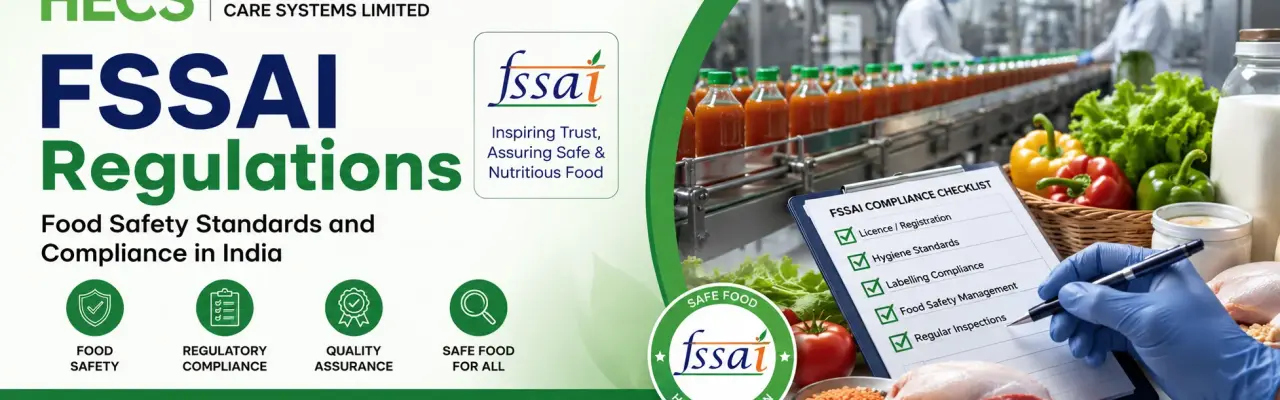


Food Safety Standards and Compliance in India
FSSAI Regulations are the legal standards framed by the Food Safety and Standards Authority of India (FSSAI) under the Food Safety and Standards Act, 2006. They govern how food is manufactured, processed, packaged, labelled, stored, distributed, and sold across India — and every food business operator, from a home-based bakery to a multinational exporter, must comply with them to legally operate.
Quick answer: FSSAI Regulations cover licensing and registration, food product standards and additives, packaging and labelling, contaminants, food safety audits, and advertising claims. As of 1 April 2026, licensing turnover thresholds were revised: Registration applies up to ₹1.5 crore, State Licence from ₹1.5 crore to ₹50 crore, and Central Licence above ₹50 crore. Operating without compliance can mean fines up to ₹10 lakh, licence cancellation, or imprisonment.
What Are FSSAI Regulations?
Under Section 92(1) of the Food Safety and Standards Act, 2006, FSSAI has the legal power to frame regulations that put the Act's broad principles into practical, enforceable detail. The first six principal regulations were notified in the Gazette of India on 1 August 2011 and took effect five days later. Since then, FSSAI has issued further regulations covering everything from organic food and food imports to advertising claims and food safety audits — there are now close to thirty notified regulations in force.
In practice, this creates a two-layer system: the Act sets out the law and establishes FSSAI's authority, while the Regulations spell out the technical standards, documentation, and procedures that a food business actually has to follow day to day.
Understanding the Food Safety and Standards Act, 2006
The FSS Act (Act No. 34 of 2006) received presidential assent on 23 August 2006. Before it, food regulation in India was split across at least seven or eight separate laws and orders — including the Prevention of Food Adulteration Act, 1954, the Fruit Products Order, 1955, the Meat Food Products Order, 1973, and the Milk and Milk Products Order, 1992 — each enforced by a different ministry. The Act repealed all of them and replaced this fragmented system with one statute and one regulator.
FSSAI itself was established on 5 September 2008 and became fully operational once its core rules and regulations were notified in 2011. It functions under the Ministry of Health and Family Welfare, with a Chairperson and 22 members drawn from government and scientific fields. One of the Act's more deliberate design choices is its emphasis on self-compliance: food businesses are expected to build internal systems — Food Safety Management Systems (FSMS) and food safety audits — rather than rely purely on inspection and punishment after the fact.
The FSSAI Regulatory Framework: Key Regulations Every Food Business Should Know
The table below covers the regulations that matter most for day-to-day compliance. The full list of close to thirty regulations is published on FSSAI's official website.
Regulation | What It Covers |
Licensing and Registration of Food Businesses Regulation, 2011 | Defines who needs Registration, a State Licence, or a Central Licence, and the application process |
Food Products Standards and Food Additives Regulation, 2011 | Composition and quality standards for specific food categories, plus permitted additives and limits |
Packaging Regulation, 2018 | Standards for packaging materials to prevent contamination and chemical migration into food |
Labelling and Display Regulations, 2020 | Mandatory label content — ingredients, nutritional information, FSSAI logo and licence number, date marking |
Contaminants, Toxins and Residues Regulation, 2011 | Maximum permissible limits for heavy metals, pesticide residues, and other contaminants |
Food Safety Auditing Regulation, 2018 | Mandates third-party audits by FSSAI-recognised auditing agencies for specified categories of FBOs |
Import Regulation, 2017 | Conditions for importing food into India, including mandatory Central Licensing |
Advertising and Claims Regulation, 2018 | Restricts misleading health, nutrition, and quality claims in advertising |
Organic Food Regulation, 2017 & Vegan Foods Regulations, 2022 | Certification and labelling requirements for organic and vegan food claims |
Who Needs FSSAI Compliance?
Any "Food Business Operator" — a term the Act applies broadly to anyone involved in any stage of the food supply chain — needs either FSSAI Registration or a Licence. This includes:
Food manufacturers and processing units
Restaurants, hotels, caterers, and cloud kitchens
Dairy, beverage, and bakery producers
Food importers and exporters
Retail chains, warehouses, and cold storage facilities
E-commerce food sellers and food delivery aggregators
FSSAI Licensing Categories: Registration vs State Licence vs Central Licence (2026 Update)
This is the area where compliance most often goes wrong, because the thresholds changed significantly and recently. Under an FSSAI order dated 13 March 2026 (Gazette Notification dated 10 March 2026), the long-standing turnover limits were replaced, effective 1 April 2026:
Category | Annual Turnover | Typically Applies To |
FSSAI Registration | Up to ₹1.5 crore (previously ₹12 lakh) | Petty manufacturers, small retailers, home-based and tiffin-scale food businesses |
State Licence | Above ₹1.5 crore up to ₹50 crore (previously ₹12 lakh–₹20 crore) | Mid-size manufacturers, processors, distributors, regional restaurant or hotel chains |
Central Licence | Above ₹50 crore (previously above ₹20 crore) | Large manufacturers, multi-state operators; also mandatory for importers, exporters, and 100% export-oriented units regardless of turnover |
Under the same reform, FSSAI licences and registrations now carry perpetual validity rather than a fixed renewal cycle — though an annual fee and Food Safety Compliance Return (FSCR) must still be filed, or the licence faces deemed suspension. All applications go through the FoSCoS portal (foscos.fssai.gov.in) using Form A for Registration or Form B for State/Central Licences.
Because this threshold change is recent, businesses that registered or licensed under the older limits should confirm their current category before their next renewal or filing.
How to Apply for FSSAI Registration or Licence
Determine your category based on turnover and business activity.
Create an account on the FoSCoS portal with your business email and mobile number. ( https://foscos.fssai.gov.in/ )
Select and complete Form A (Registration) or Form B (State/Central Licence) with business and premises details.
Upload supporting documents — identity proof, premises proof, constitution documents, and an equipment list or layout plan where required.
Pay the applicable fee and track the application until your registration or licence certificate, carrying a 14-digit unique number, is issued.
Industry-Specific FSSAI Compliance
Food Manufacturers & Processors
Subject to the Food Products Standards and Food Additives Regulation, 2011, plus mandatory food safety audits for higher-risk categories under the 2018 Auditing Regulation.
Restaurants, Hotels, Cloud Kitchens & Caterers
Need a visible licence number on premises and menus; FSSAI's hygiene rating and food safety display board requirements apply at the outlet level.
Food Importers & Exporters
Always require a Central Licence regardless of turnover, and must meet the Import Regulation, 2017, including health certificates and port-of-entry clearance.
Dairy, Beverage & Bakery Units
Subject to product-specific compositional standards (fat content, additive limits) under the Food Products Standards Regulation, plus the Labelling and Display Regulations, 2020 for nutritional declarations.
Packaged Food Brands & E-commerce Sellers
Must meet both the Packaging Regulation, 2018 and Labelling and Display Regulations, 2020 — including the FSSAI logo, licence number, and veg/non-veg mark — before listing on any marketplace.
Food Safety Audits, Inspections & Documentation
FSSAI's enforcement model rests on Food Safety Officers (FSOs), whose authority to enter and inspect food premises is equivalent to that of a police officer with a search warrant under the CrPC. Samples they collect are analysed at FSSAI-recognised or NABL-accredited laboratories. Separately, the Food Safety Auditing Regulation, 2018 requires certain categories of food businesses to undergo periodic third-party audits by FSSAI-recognised auditing agencies, in addition to maintaining their own FSMS documentation.
A practical compliance checklist includes:
Valid, displayed FSSAI registration or licence number
Up-to-date FSMS / HACCP documentation
Batch and traceability records for raw materials and finished products
Test reports from NABL-accredited or FSSAI-notified laboratories, retained and filed
Label compliance review against current Packaging and Labelling regulations
Annual Return (Form D1) filed by 31 May each year via FoSCoS
Penalties for FSSAI Non-Compliance
Section | Offence | Penalty |
Section 50 | Selling food not of the quality/substance demanded | Fine up to ₹5 lakh |
Section 51 | Manufacturing or selling substandard food | Fine up to ₹5 lakh |
Section 52 | Misbranded food | Fine up to ₹3 lakh |
Section 53 | Misleading advertisement | Fine up to ₹10 lakh |
Section 59 | Unsafe food (graded by harm caused) | Imprisonment up to 6 months–life; fine ₹1 lakh to a minimum of ₹10 lakh |
Section 63 | Operating without a licence or registration | Imprisonment up to 6 months + fine up to ₹5 lakh |
Benefits of Staying FSSAI Compliant
Legal protection against fines, license cancellation, and prosecution
Eligibility to list on marketplaces and food delivery platforms, which verify FSSAI numbers during onboarding
Smoother access to export markets and government tenders
Stronger consumer trust and brand reputation
Lower risk of product recalls and the cost that comes with them
Common FSSAI Compliance Mistakes
Applying for the wrong licence category based on outdated turnover thresholds
Missing the annual Food Safety Compliance Return, triggering deemed suspension
Labels missing the FSSAI logo, licence number, or mandatory nutritional declarations
Relying on test reports from labs that aren't NABL-accredited or FSSAI-notified
Treating compliance as a one-time exercise rather than an ongoing obligation as regulations are amended
Key takeaways
FSSAI Regulations sit under the Food Safety and Standards Act, 2006, and currently number close to thirty notified regulations.
From 1 April 2026, licensing thresholds changed to ₹1.5 crore (Registration), ₹1.5–₹50 crore (State Licence), and above ₹50 crore (Central Licence).
FSSAI licences now have perpetual validity but still require annual returns to stay active.
Non-compliance penalties range from ₹1 lakh to imprisonment for life, depending on the offence and harm caused.
Food manufacturing units typically need environmental compliance (ETP, Consent to Establish/Operate) alongside FSSAI compliance.
Why Food Businesses Benefit From Working With Experienced Compliance & Testing Partners
FSSAI compliance rarely stands alone. A food manufacturing or processing unit usually also needs to manage wastewater discharge, Consent to Establish/Operate from the State Pollution Control Board, and — depending on scale — Environmental Clearance. Handling food safety compliance and environmental compliance through separate, disconnected vendors is one of the more common reasons businesses fall behind on one or the other.
HECS(Hubert Enviro Care Systems) operates an FSSAI-notified, NABL-accredited laboratory in Chennai with dedicated chemical and microbiological divisions, using instrumentation such as GC-MS/MS, LC-MS/MS, HPLC, and ICP-MS to test for additives, contaminants, pesticide residues, and pathogens in line with FSSAI, AOAC, and FDA methods. Our government-certified food testing analysts also advise on labelling, packaging, and import/export documentation as regulations are amended. Because HECS(Hubert Enviro Care Systems) is also a 28+ year environmental engineering firm with its own environmental consultancy and effluent treatment plant capability, food businesses can work with one technical partner for both food safety testing and the environmental compliance their facility needs — rather than coordinating between separate specialists.
Need help with FSSAI compliance, food testing, or the environmental approvals that go with it?
Talk to HECS's laboratory and compliance specialists about your testing requirements, licensing category, or combined food safety and environmental compliance plan.




Share this service: