
MOEF & CC Latest Office Memorandum 2025 – Explained in a Nutshell by HECS


MOEF & CC Office Memorandum 2025 Explained – EC, CTE, and Parivesh 2.0 Simplified
The MOEF & CC Office Memorandum released on October 8, 2025, introduces a major update in India’s environmental regulatory process, focusing on smoother coordination and faster clearances through the Parivesh 2.0 portal. This update simplifies how industries, infrastructure projects, and developers handle Environmental Clearance (EC) and Consent to Establish (CTE), ensuring greater transparency and accountability.
At Hubert Enviro Care Systems (HECS), we recognise that keeping up with such regulatory changes can be complex. That’s why our team of environmental consultants has simplified the MOEF&CC Office Memorandum into an easy-to-understand summary, highlighting the key updates that impact projects under categories B2, B1, and A, including those that have obtained EC after November 12, 2024, but are yet to secure CTE or CFE.
Stay informed with HECS — India’s leading environmental management company — for clear insights and expert environmental guidance.
1. Category B2 Projects – Simplified EC and SPCB Coordination Process
Applicable Projects: Built-up area above 20,000 sq.m and below 1,50,000 sq.m.
The MOEF&CC Office Memorandum 2025 simplifies the EC and CTE coordination process for Category B2 projects through Parivesh 2.0, ensuring faster environmental clearance and better communication between SEAC, SEIAA, and SPCB.
Here’s the step-by-step process as per the latest guidelines:
Step 1: Submission of EC Application
The Project Proponent (PP) must submit Form-1, Form-1A, and Conceptual Plan / EMP through the Parivesh 2.0 portal.
This marks the initiation of the Environmental Clearance (EC) process.
Step 2: SEAC Scrutiny and EDS Clarification
The State Expert Appraisal Committee (SEAC) reviews the application.
If Essential Details Sought (EDS) are raised, the PP must address them promptly on the Parivesh portal.
If no EDS is raised, the proposal proceeds to the next stage.
Step 3: SEAC Fee Payment
Once SEAC scrutiny is complete, the PP pays the SEAC processing fee using the proposal number.
The payment receipt must be uploaded along with the application in Parivesh 2.0 for record verification.
Step 4: Auto-Forwarding to SPCB
Upon successful submission, the proposal is automatically forwarded to the State Pollution Control Board (SPCB) through the Parivesh 2.0 system for comment collection.
Step 5: SPCB Demand Note
The SPCB issues a Demand Note within 7 days of the ToR (Terms of Reference) grant.
The demand note includes CTE fee details and SPCB account information, which appear in Parivesh 2.0.
Step 6: CTE Fee Payment by PP
The PP pays the CTE fee using the provided SPCB account details.
The payment receipt must be uploaded to the Parivesh 2.0 portal for verification.
Step 7: Verification by SPCB
The SPCB verifies the payment and proceeds to upload its comments on the proposal.
This may include a site inspection, if required.
Step 8: SPCB Comment Timeline
The SPCB must upload comments within 15 days of the date the payment receipt is uploaded by the PP.
If no comments are received within this period, the project is treated as having “Deemed No-Objection.”
Step 9: SEAC Appraisal & EC Grant
The SEAC schedules a meeting to appraise the EC application.
The SPCB representative is invited to provide inputs.
If no SPCB comments are received, the project proceeds with Deemed No-Objection status.
The State Environment Impact Assessment Authority (SEIAA) then grants Environmental Clearance (EC).
2. Category B1 Projects – EC Linked with SPCB Coordination
Applicable Projects:
Built-up area above 1,50,000 sq.m or total area over 50 hectares
All other B1 category projects listed under the EIA Notification 2006 and its subsequent amendments
The MOEF&CC Office Memorandum 2025 introduces a coordinated process between SEAC/SEIAA and the SPCB through Parivesh 2.0, ensuring that the Environmental Clearance (EC) and Consent to Establish (CTE) stages are seamlessly integrated.
Here’s the step-by-step process flow for Category B1 projects: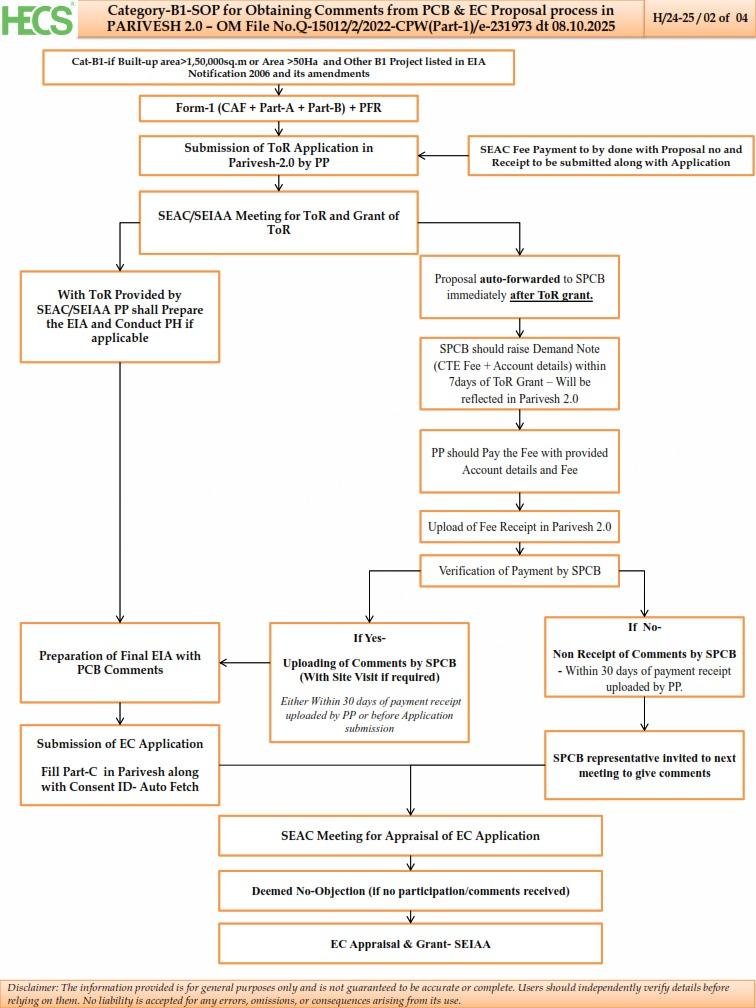
Step 1: Submission of ToR Application
The Project Proponent (PP) applies Parivesh 2.0, including:
Form-1 (CAF + Part-A + Part-B)
Pre-Feasibility Report (PFR)
This initiates the Terms of Reference (ToR) process for Environmental Impact Assessment (EIA).
Step 2: ToR Review and Grant by SEAC/SEIAA
The SEAC/SEIAA reviews the ToR application and conducts a meeting to grant ToR approval.
Once the ToR is issued, the PP proceeds to the next stage.
Step 3: SEAC Fee Payment (for State projects in ToR application submission time)
The PP must pay the SEAC processing fee, ensuring that the proposal number is mentioned.
The payment receipt should be uploaded along with the application in the Parivesh 2.0 portal.
Step 4: Preparation of EIA Report & Public Hearing
Using the granted ToR, the PP prepares the EIA Report in line with the prescribed terms.
If applicable, a Public Hearing (PH) is conducted under the supervision of the SPCB.
Step 5: Auto-Forwarding to SPCB
After ToR grant, the proposal is automatically forwarded to the SPCB through Parivesh 2.0 for CTE coordination and comments.
Step 6: SPCB Demand Note
The SPCB issues a Demand Note within 7 days of the ToR grant.
The note includes CTE fee details and bank account information, visible in Parivesh 2.0.
Step 7: Fee Payment & Upload by PP
The PP pays the CTE fee as per SPCB instructions.
The fee receipt must be uploaded on Parivesh 2.0 for verification.
Step 8: SPCB Verification & Comment Submission
The SPCB verifies the payment and proceeds with either of the following:
Uploading Comments: Within 30 days of payment receipt (with site visit if required).
No Comments Received: The case is treated as having a “Deemed No-Objection.”
SPCB comments can also be uploaded before the PP submits the final EC application, ensuring faster processing.
Step 9: Final EIA Submission
The PP finalises the EIA Report after considering SPCB comments (if available).
The EC application is then submitted by filling Part C in Parivesh 2.0, along with the Consent ID, which is auto-fetched from the SPCB database.
Step 10: SEAC Appraisal & EC Grant
The SEAC conducts a meeting to appraise the EC application.
The SPCB representative is invited to present observations or comments.
If no SPCB comments are received, it is treated as Deemed No-Objection.
Finally, the State Environment Impact Assessment Authority (SEIAA) grants the Environmental Clearance (EC).
3. Category A Projects – Centralized EC Process under EAC
Applicable Projects:
Projects listed under the EIA Notification 2006 and its subsequent amendments that require central-level appraisal fall under Category A.
These projects undergo scrutiny and approval by the Expert Appraisal Committee (EAC) at the MoEF&CC level.
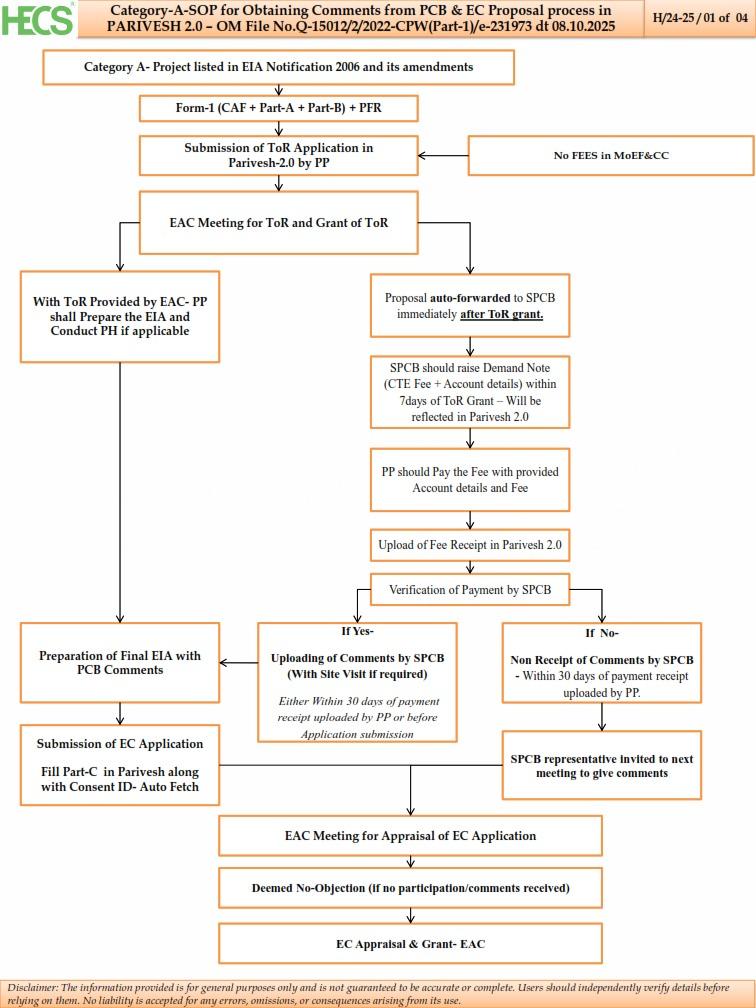
The 2025 MOEF&CC Office Memorandum introduces a more integrated EC and CTE process, enabling faster decision-making and transparent coordination between the Project Proponent (PP), SPCB, and EAC through Parivesh 2.0.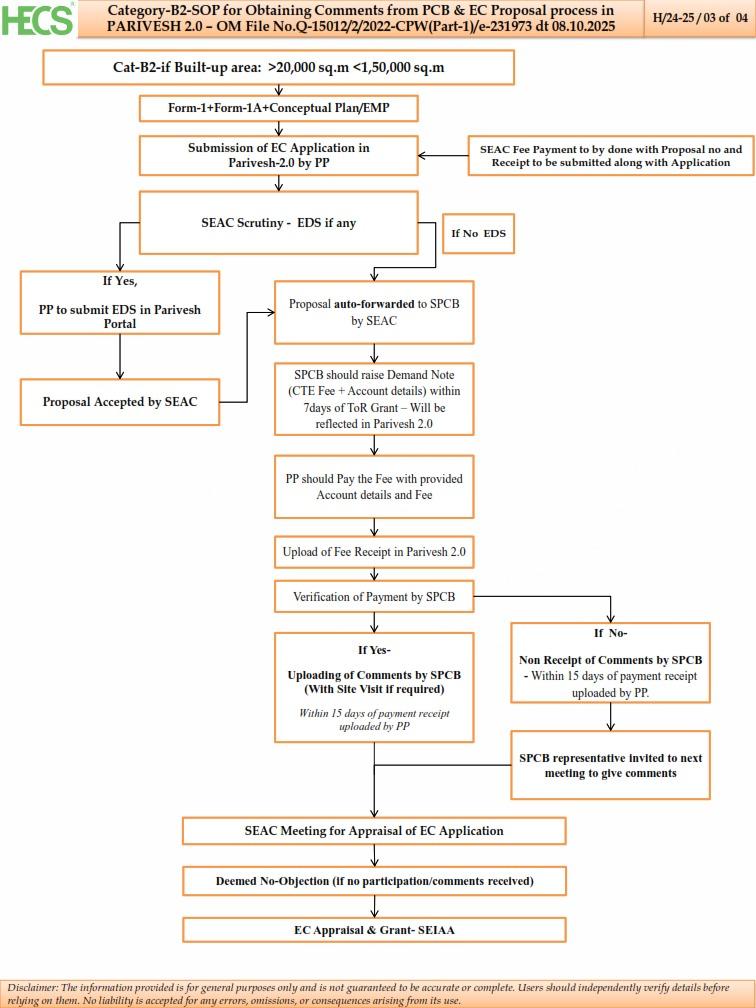
Step 1: Submission of ToR Application
The Project Proponent (PP) submits the application via Parivesh 2.0, including:
Form-1 (CAF + Part-A + Part-B)
Pre-Feasibility Report (PFR)
This initiates the Terms of Reference (ToR) process for EIA preparation.
Step 2: EAC ToR Review and Grant
The Expert Appraisal Committee (EAC) reviews the ToR application in its scheduled meeting.
Upon review, ToR is granted to the project, setting the scope for the EIA study.
Step 3: EIA Preparation & Public Hearing
With the ToR granted, the PP prepares the EIA Report as per the defined terms.
A Public Hearing (PH) is conducted under SPCB supervision, wherever applicable, ensuring stakeholder participation.
Step 4: Auto-Forwarding to SPCB
After ToR approval, the proposal is auto-forwarded to the SPCB via Parivesh 2.0 for CTE-related processing and comments.
Step 5: SPCB Demand Note
The SPCB issues a Demand Note within 7 days of ToR grant.
This includes the CTE fee details and bank account information, visible on Parivesh 2.0.
(Note: There is no fee payable to MoEF&CC at this stage.)
Step 6: Fee Payment & Upload by PP
The PP pays the CTE fee as per SPCB’s demand note.
The payment receipt is uploaded in Parivesh 2.0, enabling verification by the SPCB.
Step 7: SPCB Verification & Comment Submission
The SPCB verifies the payment and uploads its comments (with or without a site visit) within 30 days of payment receipt.
If no comments are received within this period, the project is treated as having a “Deemed No-Objection.”
Step 8: Final EIA Submission & EC Application
The PP finalizes the EIA Report considering SPCB comments (if any).
The EC Application is then submitted by filling Part-C in Parivesh 2.0, along with the Consent ID, which is auto-fetched from the SPCB database.
Step 9: EAC Appraisal & EC Grant
The EAC conducts the final appraisal meeting for the EC application.
The SPCB representative is invited to present comments or clarifications, if available.
In case of no SPCB participation or comments, it is treated as a Deemed No-Objection.
The EAC grants the Environmental Clearance (EC) at the central level through the MoEF&CC.
4. EC Obtained After November 12, 2024 – New CTE Exemption Clause
The MOEF&CC Office Memorandum (October 8, 2025) introduces a major regulatory relief for projects that have already received Environmental Clearance (EC) after November 12, 2024, but have not yet applied for Consent to Establish (CTE).
This new clause simplifies the compliance process by eliminating the need for a separate CTE application, ensuring faster implementation and smoother coordination through the Parivesh 2.0 system.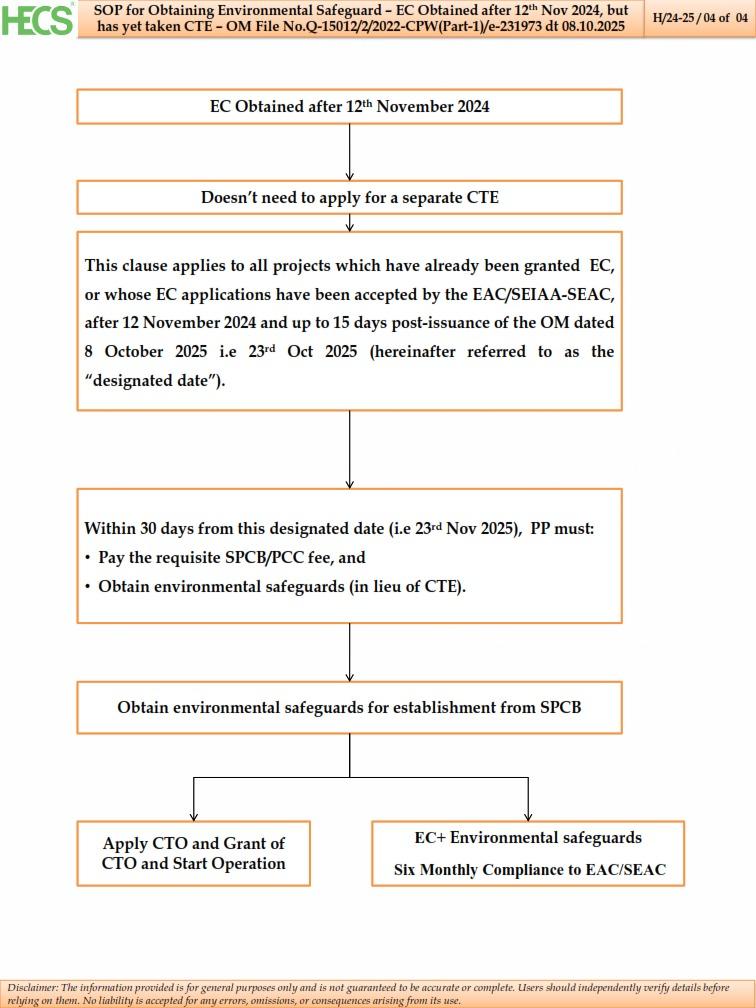
Step 1: Applicability of the Clause
This exemption applies to all projects that meet the following criteria:
EC has already been granted by EAC/SEIAA-SEAC after November 12, 2024, or
EC applications that were accepted and under consideration by EAC/SEIAA-SEAC up to 15 days post-issuance of the OM dated October 8, 2025.
👉 This means all eligible projects up to the designated date of October 23, 2025 fall under this clause.
Step 2: No Separate CTE Application Required
Such projects do not need to apply separately for CTE.
Instead, they can directly proceed with environmental safeguard requirements and CTO (Consent to Operate) after fulfilling the prescribed steps.
Step 3: Payment Timeline & Requirements
Within 30 days from the designated date (i.e., by November 23, 2025 which may further extented within state PCB), the Project Proponent (PP) must:
1. Pay the requisite fee to the SPCB/PCC (State Pollution Control Board / Pollution Control Committee) as per the prescribed schedule.
2. Obtain Environmental Safeguards issued by the SPCB instead of CTE — serving as proof of compliance during the establishment phase.
Step 4: Environmental Safeguards instead of CTE
After the fee payment, the SPCB will issue Environmental Safeguards for project establishment.
These safeguards replace the traditional Consent to Establish (CTE), ensuring projects maintain environmental accountability without additional administrative delays.
Step 5: Apply for CTO (Consent to Operate)
Once safeguards are obtained, the PP applies for CTO (Consent to Operate).
The CTO grant enables the project to officially commence operations under the approved environmental framework.
Step 6: Compliance Obligations
Projects must ensure regular submission of six-monthly compliance reports to the EAC/SEAC, covering:
Implementation of Environmental Management Plans (EMP).
Monitoring results as per Environmental Clearance conditions.
Status of safeguard implementation issued by SPCB.
Partner with HECS – India’s Best Environmental Management Company for MOEF&CC Compliance
The MOEF&CC Office Memorandum (8th Oct 2025) marks a major advancement in streamlining environmental clearance workflows through Parivesh 2.0. By setting clear timelines, automating coordination between SEAC/SEIAA, EAC, and SPCBs, and introducing a CTE exemption for recent Environmental Clearance (EC) holders, the ministry ensures faster, more transparent, and accountable compliance.
As India’s best environmental management company, HECS stands at the forefront of regulatory compliance and sustainable development. Recognised as a top environmental consultancy in India, we provide complete environmental management services — including EIA studies, EC/CTE documentation, pollution monitoring, and compliance reporting — to help industries meet the latest MOEF&CC guidelines with confidence.
👉 Contact HECS today — India’s leading environmental consultant — for expert support in achieving environmental compliance and project approvals with ease.
Disclaimer: The information provided is for general purposes only and is not guaranteed to be accurate or complete. Users should independently verify details before relying on them. No liability is accepted for any errors, omissions, or consequences arising from its use.
Share this post: