

Comprehensive Guide to CTE & CTO Regulations: CPCB, SPCB & TNPCB Compliance Updates (2026-2027)
-
Home
-
Regulatory Updates
-
Comprehensive Guide to CTE & CTO Regulations: CPCB, SPCB & TNPCB Compliance Updates (2026-2027)

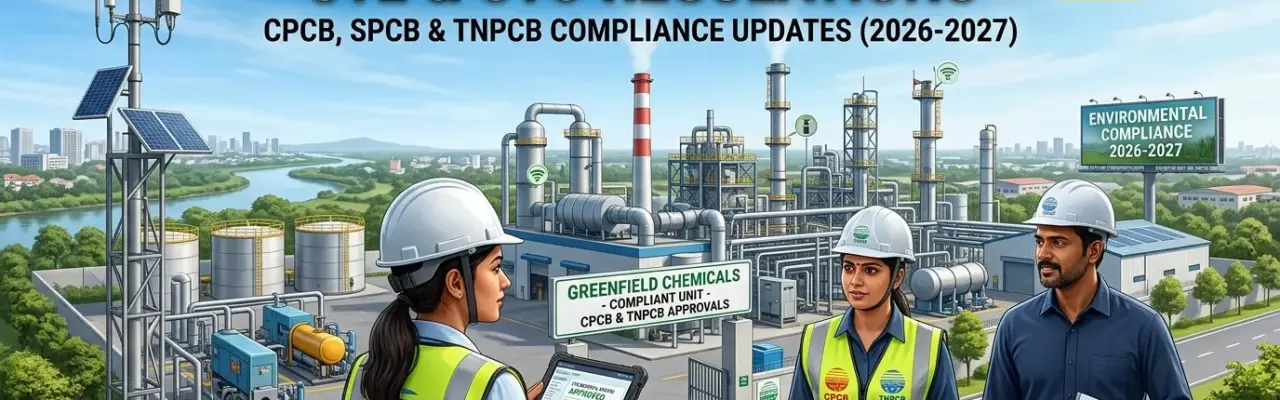


Your Complete Resource for Consent to Establish (CTE) and Consent to Operate (CTO) in India
CTE and CTO Regulations in India
Environmental compliance in India has undergone a significant transformation. The Central Pollution Control Board (CPCB) and State Pollution Control Boards (SPCBs) have implemented robust digital frameworks to regulate industrial operations. The Consent to Establish (CTE) and Consent to Operate (CTO) framework represents the cornerstone of India's environmental regulatory mechanism.
Understanding these regulations is not merely a legal requirement; it is a fundamental aspect of responsible industrial operations that ensures business continuity and environmental integrity.
The Shift to Digital Compliance
The regulatory landscape has evolved dramatically with the introduction of:
Online Consent Management Systems: Streamlining applications.
Integrated Approvals: Simplifying the clearance process.
This guide provides an in-depth analysis of CTE and CTO regulations, specifically covering CPCB, SPCBs, and the Tamil Nadu Pollution Control Board (TNPCB), along with the latest compliance requirements for 2026-2027.
What is Consent to Establish (CTE)?
Consent to Establish (CTE) is the primary environmental authorization industries must obtain before commencing any construction or establishment activities.
Legal Framework
CTE is mandated under:
Section 25 of the Water (Prevention and Control of Pollution) Act, 1974.
Section 21 of the Air (Prevention and Control of Pollution) Act, 1981.
Purpose of CTE
CTE serves as the first regulatory checkpoint. It ensures that proposed industrial projects have adequate pollution control measures designed into their infrastructure from the outset. The process involves a thorough evaluation of:
Proposed project sites.
Pollution control technologies.
Environmental impact assessments.
Compliance with zoning regulations.
Key Requirements for CTE Application
While the CTE application process is streamlined through online portals, documentation requirements remain comprehensive. Industries must prepare a Detailed Project Report (DPR) encompassing manufacturing processes, raw materials, and pollution control strategies.
Checklist for CTE Application:
Detailed Project Report (DPR): Comprehensive documentation covering project scope, process flow diagrams, and technical specifications.
Site Plan and Layout: Detailed plans showing location, nearby water bodies, residential areas, and environmental sensitivity mapping.
Pollution Control System Design: Technical specs for Effluent Treatment Plants (ETP), Sewage Treatment Plants (STP), and air pollution control equipment.
Environmental Impact Assessment (EIA): Required for specific projects as per MoEF&CC guidelines.
Land Documents and Zoning Compliance: Proof of ownership/lease and confirmation of location in an approved industrial zone.No Objection Certificates (NOCs): From local bodies, fire departments, and other statutory authorities.
Consumption and Emission Details: Data on water consumption, energy usage, raw material input, and expected emissions/discharge levels, including air, water, and solid waste outputs.
What is Consent to Operate (CTO)?
Consent to Operate (CTO) is the operational authorization granted after an industry has been established and all pollution control systems are commissioned. This consent validates that the industry meets environmental standards and can legally commence production.
CTO Validity Period
The validity of CTO varies based on industry categorization:
Red Category: 5 Years
Orange Category: 10 Years
Green Category: Up to 15 Years
White Category: Exempted (Intimation only)
Essential Requirements for CTO Application
Industries must demonstrate full compliance with CTE conditions and proper installation of pollution control infrastructure.
Copy of Valid CTE: Submission of the original CTE along with compliance reports.
Commissioning Certificates: Confirmation of successful commissioning of ETP, STP, and air pollution control systems.
Analysis Reports: Lab test results for effluent and emissions from NABL-accredited laboratories.
Consent Fee Payment: Proof of payment based on capital investment and water consumption.
Environmental Management Plan: Operational procedures for pollution control and emergency response.
CPCB Latest Compliance Updates (2025-2026)
The Central Pollution Control Board has introduced transformative changes to streamline consent management.
1. 100% Online Application Processing
The CPCB has mandated complete digitization through the Online Consent Management and Monitoring System (OCMMS).
Benefit: Hard copy needs to be submitted.
Feature: Real-time tracking, automated notifications, and online fee payment.
Integration: Connects with government databases for automated document verification.
2. Real-Time Effluent and Emission Data Submission
Mandatory installation of Online Continuous Effluent/Emission Monitoring Systems (OCEMS) is now a cornerstone of compliance.
Requirement: Red and Orange category industries must transmit real-time data to CPCB/SPCB servers.
Parameters: Includes pH, COD, BOD, TSS, Particulate Matter, SOx, and NOx.
Outcome: Continuous surveillance replaces periodic inspections.
TNPCB - Latest CTE/CTO Compliance Updates
The Tamil Nadu Pollution Control Board (TNPCB) is a pioneer in digital governance, utilizing the OCMMS for paperless processing.
Fully Digital OCMMS Application System
TNPCB’s portal allows industries to register, submit applications, upload documents, and pay fees online.
Automated Workflow: Applications progress through defined stages with real-time notifications.
Transparency: Maintains complete audit trails.
Mandatory Online Compliance Reporting
Consent-holding industries must submit monthly reports via the OCMMS portal.
Standardization: Ensures consistency in data submission.
Scope: Covers effluent quality, emission data, and hazardous waste generation.
Strict Renewal Timelines Enforcement
Deadline: Apply for CTO renewal at least 90 days before expiry.
Consequences: Late applications face enhanced scrutiny and potential procedural delays.
Enforcement: Includes show cause notices and closure orders for non-compliance.
Stricter Verification Requirements
TNPCB has enhanced verification for critical parameters:
Zero Liquid Discharge (ZLD): Mandatory for water-stressed regions and highly polluting industries. Requires verification of recycling/reuse systems.
Hazardous Waste Authorization: Separate authorization required under the Hazardous Wastes Rules, 2016.
Plastic Waste EPR Compliance: Producers and Brand Owners must verify EPR registration and recycling targets.
New Compliance Requirements for Industries
Industries must adapt to enhanced monitoring and reporting obligations.
Quarterly Effluent Quality Testing
Requirement: Testing through NABL-accredited labs.
Submission: Results submitted online to supplement OCEMS data.
Protocol: Includes physical, chemical, and biological parameter analysis.
Online Data Uploading Requirements
Industries must upload diverse operational data:
Flow Meter Data: Daily water intake and discharge readings.
Treated Water Reuse Data: Quantity and application of reused wastewater.
Sludge Disposal Records: Manifests from authorized disposal facilities.
Digital Inspection and Surprise Audits
Digital Inspections: Inspectors use mobile apps for geo-tagged photos and real-time report uploads.
Surprise Audits: Data analytics identify high-risk facilities for unannounced inspections (including nights/weekends).
Industry Classification and Consent Validity
CPCB classifies industries based on the Pollution Index (PI), which considers water pollution, air pollution, and hazardous waste generation.
Category | Pollution Index (PI) | CTO Validity | Inspection Frequency |
Red | PI ≥ 60 | 5 Years | Every 6 Months |
Orange | 41 ≤ PI < 60 | 10 Years | Annually |
Green | 21 ≤ PI < 41 | 15 Years | Every 2 Years |
White | PI < 20 | Exempted | Risk-Based |
Official Government Resources
Bookmark these official portals for direct access to consent systems and guidelines.
CPCB Official Portal: https://cpcb.nic.in
CPCB EPR Portal: https://eprplastic.cpcb.gov.in
TNPCB Official Website: https://tnpcb.gov.in
TNPCB OCMMS Portal: https://ocmms.tn.gov.in
PARIVESH (EC Portal): https://parivesh.nic.in
CPCB OCEMS Live Data: https://cpcb.nic.in/ocems-live-data
Professional Compliance Assistance
Navigating Consent to Establish (CTE) and Consent to Operate (CTO) approvals requires deep regulatory expertise, technical documentation accuracy, and strong coordination with Pollution Control Boards. A minor compliance gap can lead to project delays, penalties, or operational shutdowns.
HECS – Hubert Enviro Care Systems is a leading environmental compliance consultant in India, helping industries secure fast CTE approvals, smooth CTO renewals, and end-to-end pollution control compliance without delays. We combine regulatory knowledge with technical execution to deliver reliable, result-driven support.
Our Expert Compliance Services
CTE Application Processing & Documentation – Complete DPR preparation, pollution load calculations, Environmental Management Plans, and PCB liaison for faster project clearance.
CTO Renewal & Compliance Management – Timely filing, compliance audits, and regulatory risk mitigation to prevent penalties.
OCEMS Installation & Monitoring Support – Approved Online Continuous Emission Monitoring Systems integration and real-time compliance reporting.
ZLD System Design & Certification – Zero Liquid Discharge solutions with technical validation and regulatory approvals.
EPR Registration & Annual Filing – CPCB registration, documentation handling, and annual return submission support.
Secure Faster Environmental Approvals with HECS
India’s regulatory landscape is shifting toward smart verification, digital compliance systems, and strict real-time monitoring. Industries that treat environmental compliance as a strategic investment will experience uninterrupted operations and long-term stability.
Don’t risk rejection, penalties, or project delays.
Get expert support for CTE, CTO, OCEMS, ZLD, and EPR approvals from a trusted environmental compliance partner.
HECS – Your Reliable Partner for Environmental Clearance & Industrial Compliance in India.


Disclaimer: The above information is provided for general guidance only. All CTE, CTO, OCEMS, ZLD, and EPR approvals are subject to the respective regulatory authorities’ rules and decisions.
Share this service: