


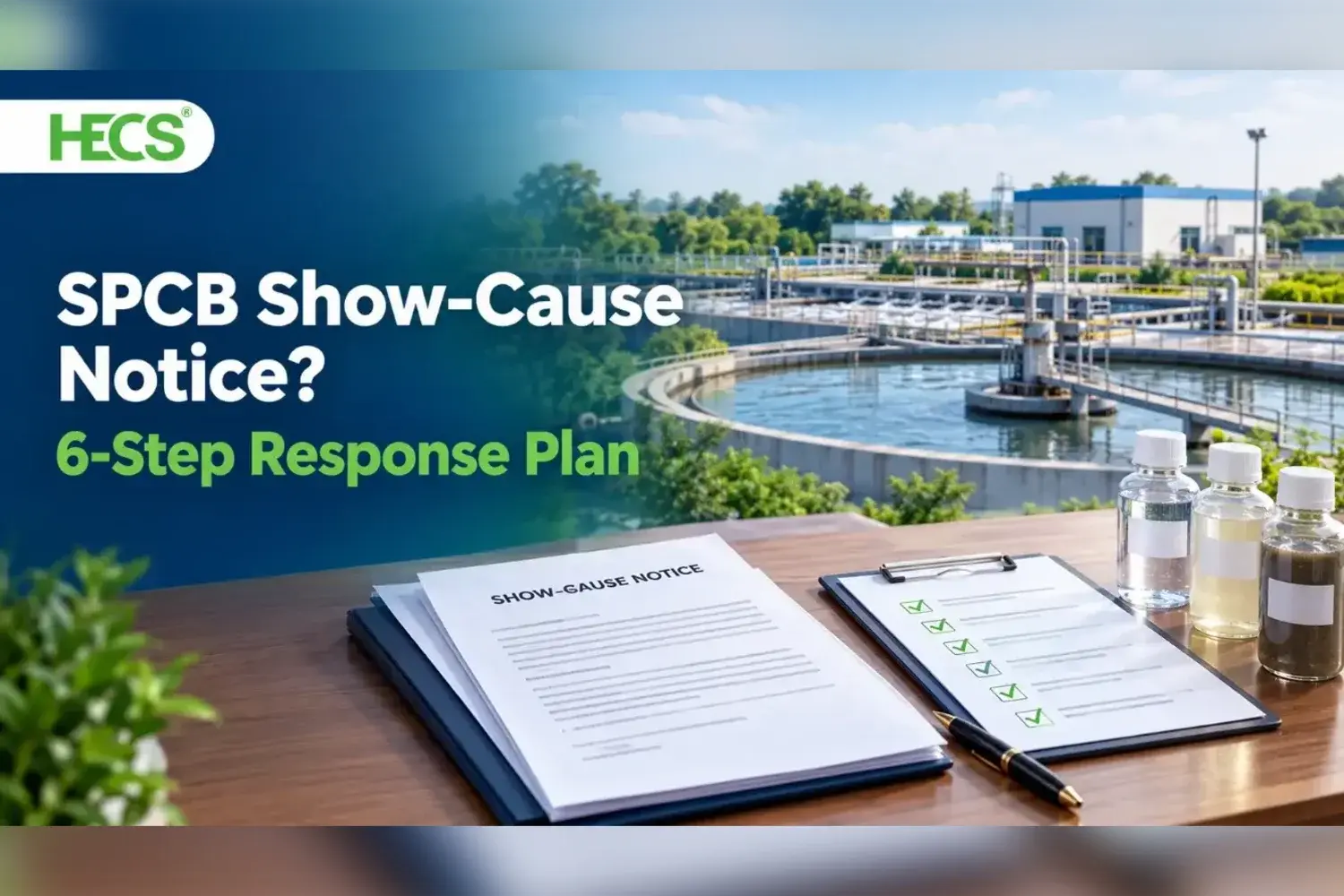
Received an SPCB Show-Cause Notice? A 6-Step Response Plan

The notice usually arrives weeks after an SPCB inspection. A treated-effluent sample exceeded a consent limit, the ETP logbook had gaps, or a consent condition was missed. Now the unit has a fixed number of days to explain itself.
An SPCB show-cause notice should never be ignored or answered generically. A response that holds up follows a sequence: understand the allegation, verify facts, find the root cause, assemble evidence, act and reply within the deadline.
Quick Answer
What should you do after receiving an SPCB show-cause notice? Note the reply deadline, read every allegation and match it against your records. Collect consent orders, test reports and operating logs, identify the root cause of each non-compliance and start corrective action immediately. Submit a point-by-point reply with evidence and a dated action plan through the channel the notice specifies, and keep proof of submission.
SPCB Show-Cause Notice Checklist
-
 Record the reply deadline and any hearing date
-
List each allegation and the condition or parameter cited
-
Pull your Consent to Establish (CTE), Consent to Operate (CTO) and relevant conditions
-
Match test reports and logs to inspection dates
-
Fix the root cause, not the symptom
-
Reply point by point with numbered annexures
-
Take legal advice if prosecution, closure or compensation is mentioned
-
Submit through the specified channel and keep proof
What Is an SPCB Show-Cause Notice?
A show-cause notice is a formal letter from a State Pollution Control Board (SPCB), or a Pollution Control Committee in a Union Territory, asking a unit to explain why action should not be taken for an alleged non-compliance.
Notices commonly concern consent conditions under the Water Act, 1974 or Air Act, 1981, effluent or emission results, pollution-control equipment, monitoring, waste management, records or earlier Board directions. Read the wording closely: your reply must answer what the Board actually alleged.
It is not a direction, closure order, environmental compensation demand or prosecution, though any of these may follow in some cases. TNPCB's published material, for example, indicates non-compliance may lead to legal action, closure directions or stoppage of power supply in appropriate cases. A notice alone does not mean they will.
The 6-Step Response Plan at a Glance
- Read the notice line by line: note every allegation, parameter, date, document requested and the reply deadline.
- Build a compliance evidence file: collect consents, test reports, logs and records that relate to the allegations.
- Identify the root cause: diagnose the ETP, STP or consent gap before spending on chemicals or equipment.
- Prepare a corrective action plan: set immediate and permanent actions, with evidence, for each issue.
- Draft the SPCB reply: answer point by point, in the notice's order, with numbered annexures.
- Verify and submit: check every answer, sign, submit through the required channel and keep proof.
Step 1: Read the Notice Line by Line
Before drafting anything, establish exactly what the Board has identified as non-compliant. Note:
- Notice date, reference number and legal provisions cited
- Each alleged non-compliance, with parameters or conditions
- Inspection and sampling dates
- Documents requested
- Reply deadline, hearing details and stated consequences
Need more time? Request an extension in writing before the deadline; granting it is the Board's call.
Step 2: Build a Compliance Evidence File
Collect only what relates to the allegations:
- CTE, CTO, latest renewal and relevant consent conditions
- Effluent, emission and water test reports, preferably from a NABL-accredited laboratory
- ETP/STP operating logs, flow and chemical-dosing records
- Maintenance and calibration records for blowers, pumps and flow meters
- Waste disposal records, where applicable
- Past inspection reports, SPCB correspondence, dated photographs and invoices
An explanation without dated records carries little weight.
Step 3: Identify the Root Cause
A common mistake is treating the notice as a paperwork exercise. If the plant problem remains, the next sample tells the same story.
ETP outlet exceeds a consent limit. Check influent characteristics, hydraulic and organic loading, chemical dosing, aeration, sludge wasting, equipment and sampling practice in your effluent treatment plant.
STP performance issue. Review dissolved oxygen, MLSS, sludge return, loading versus design capacity and O&M of the sewage treatment plant, then confirm treated-water quality with fresh tests.
Consent-condition deviation. Compare actual operations with the wording of each condition and pinpoint the exact gap.
Diagnose before you spend on chemicals or equipment. For a deeper look at ETP stages and performance, see our effluent treatment plant guide.
Step 4: Prepare a Corrective Action Plan
The Board wants to know what happened and why it will not recur. For each issue:
| Issue | Root cause | Immediate action | Permanent action | Evidence |
|---|---|---|---|---|
| High outlet COD | Blower failure | Blower repaired | Standby blower, preventive maintenance | Service report, fresh test report |
| Logbook gaps | Untrained night-shift operator | Readings recovered from meters | Operator training, shift checklist | Training record, updated log |
Permanent fixes usually depend on disciplined operation and maintenance, not one-off repairs.
Step 5: Draft the SPCB Reply
A strong reply generally includes:
- Notice reference, date and brief acknowledgement
- Point-by-point response in the notice's order
- Factual explanation with numbered annexures
- Corrective actions completed
- Action plan for pending items, with target dates
- Commitment to continued compliance
- Authorised signatory's name and designation
Stay factual. If findings are disputed, or prosecution, closure or environmental compensation is involved, consult an environmental lawyer.
Step 6: Verify and Submit
Confirm that:
- Every allegation is answered
- Dates, test reports and consent conditions match
- Nothing contradicts earlier submissions
- The authorised signatory has signed
- It uses the required channel, meets the deadline and you keep proof
What Happens After the Reply?
It depends on the notice, the applicable law and the Board's process. The SPCB may accept the reply, seek documents, re-inspect or re-sample, hold a hearing, issue directions or begin environmental compensation or other proceedings. Not every case involves all of these.
When Should You Engage an Environmental Consultant?
Involve an environmental compliance consultant when the notice raises technical questions your team cannot answer with evidence:
- Effluent, emission or treated-water parameters are cited
- ETP or STP performance is questioned
- Multiple gaps or complex consent conditions exist
- The fix needs engineering or independent testing
- A hearing or re-inspection is expected
Need Help Responding to an SPCB Notice?
Hubert Enviro Care Systems (HECS), a Chennai-based environmental engineering and consultancy company since 1997, supports the technical side of compliance:
- Environmental compliance assessment
- Water, wastewater and effluent testing
- ETP and STP performance assessment and optimisation
- Pollution-control system evaluation and environmental monitoring
- Corrective-action planning
HECS does not provide legal representation or guarantee regulatory outcomes; we help you find the technical cause and build the evidence behind your reply.
Received an SPCB show-cause notice? Don't wait until the deadline is close. Share the notice and recent test reports for an initial discussion: call 044-35391255 or send an enquiry.
This article is general compliance guidance, not legal advice. Requirements vary by state, industry and consent conditions.
Share this post: