


What Is Environmental Testing? A Practical Guide for Indian Industries

Quick answer Environmental testing is the laboratory analysis of water, air, soil, effluent, emissions, and noise to check they stay within legal safety limits. Indian industries rely on it to renew pollution control board consents, pass audits, protect workers, and avoid closure notices — using reports from a NABL-accredited environmental laboratory.
A single envelope can change a plant manager’s week. It arrives from the State Pollution Control Board, references a consent condition, and asks for something you were meant to submit last month. Suddenly, environmental testing stops being a line item and becomes the thing standing between you and a show-cause notice.
That scenario plays out across Indian industry every day — in dyeing units, hospitals, food plants, and townships. The good news is that environmental testing is not complicated once you understand what it covers and why regulators lean on it so heavily. This guide breaks it down in plain language, for the people who actually deal with it.
➤ Facing a deadline right now? WhatsApp us
What is environmental testing, really?
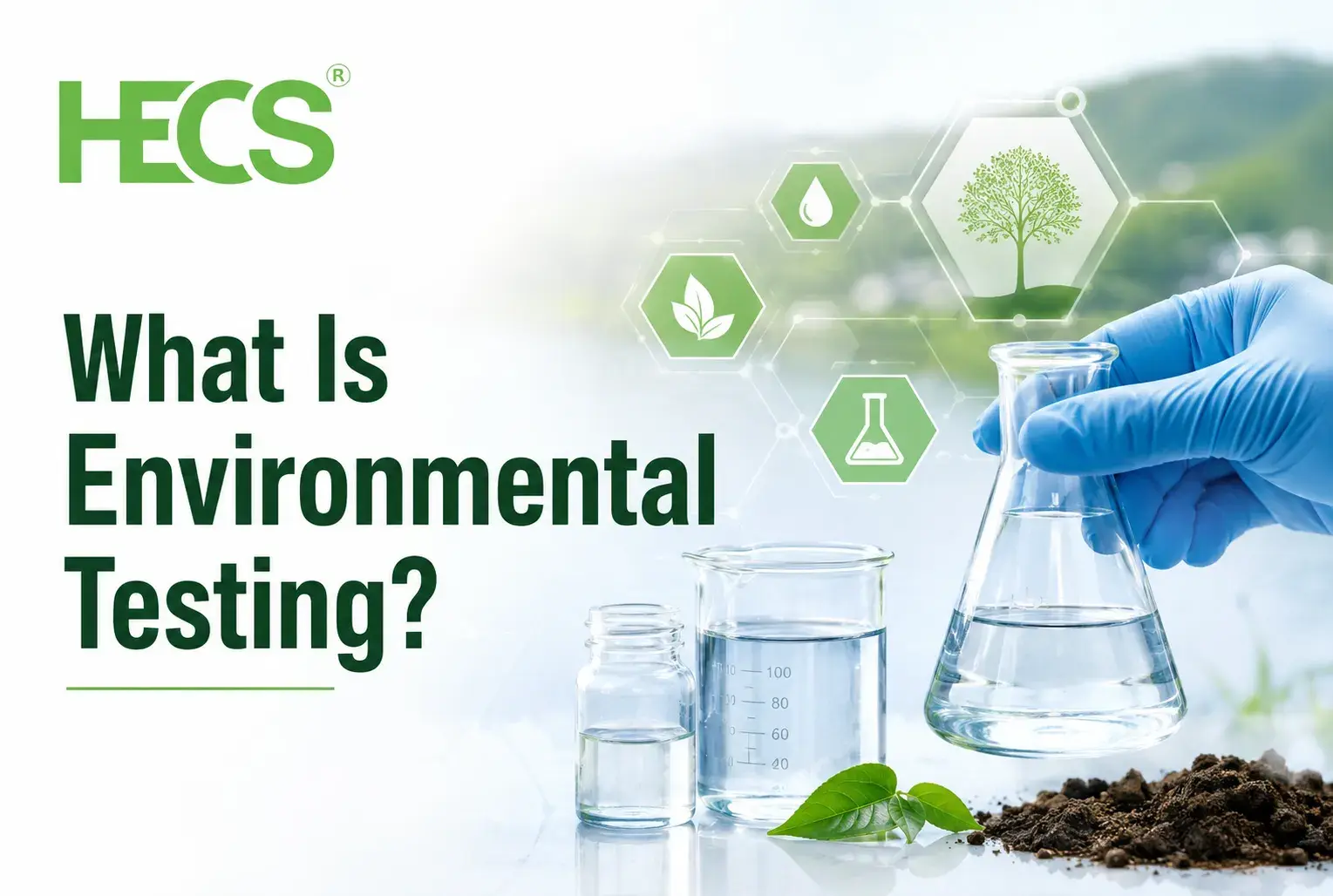
At its core, environmental testing measures what your operations release into the world — and whether those releases are safe. A trained team collects samples of water, air, soil, or emissions, and a laboratory analyses them against Indian standards. The output is a test report: numbers, limits, and a clear pass or fail.
Those numbers do a lot of heavy lifting. They tell a regulator your effluent is within discharge limits. They tell an auditor your treatment plant works. And they tell you, honestly, whether the systems you paid for are doing their job. It is one of the few places in compliance where you cannot argue with the evidence.
What are the main types of environmental testing?
Most industries deal with six broad categories. You may need one or all of them, depending on what your consent conditions say and what your process actually emits.
Type | What it checks | Common at |
Drinking, borewell, process & treated water quality | Hospitals, hotels, food plants, offices | |
Wastewater / effluent | ETP & STP performance, discharge compliance | Factories, chemical & textile units |
Ambient air | PM2.5, PM10, SO₂, NOx, CO around your site | Manufacturing, power, construction |
Stack emissions | Flue gas from boilers, DG sets, chimneys | Any site with combustion sources |
Soil testing | Contamination, heavy metals, hydrocarbons | Industrial land, EIA, remediation |
Noise monitoring | Day/night noise against CPCB limits | Industrial & mixed-use zones |
If you run more than one of these, it is usually simpler — and cheaper — to test them through a single accredited laboratory rather than juggling separate vendors and report formats.
Which parameters get tested, and against what standards?
Every test measures specific parameters, and each parameter is judged against a published Indian standard. This is where accreditation earns its keep, because the method behind each number has to be traceable and defensible.
Sample | Key parameters | Benchmark |
Drinking water | pH, TDS, hardness, fluoride, nitrate, coliform | IS 10500:2012 |
Effluent | BOD, COD, TSS, oil & grease, heavy metals | SPCB consent limits |
Ambient air | PM2.5, PM10, SO₂, NOx, CO, ozone | NAAQS (CPCB) |
Stack emission | Particulate matter, SO₂, NOx, velocity, temp | CTO limits |
Noise | Day & night dB(A) by zone | CPCB Noise Rules |
Who actually needs environmental testing?
Short answer: almost every regulated operation in India. But the people who feel it most are the ones whose signature goes on the compliance file. If any of these describe you, testing is already part of your job.
● Plant heads and factory owners — your consent to operate depends on effluent and emission results.
● EHS and compliance managers — you own the monitoring calendar and the audit trail.
● Hospital and facility administrators — STP performance, water safety, and biomedical waste all get checked.
● Project managers and developers — new projects need EIA baseline data before clearance.
● Food, hotel and township operators — water quality and treated-water discharge are recurring obligations.
The common thread is simple. If a regulator can ask you to prove something about your environmental footprint, you need data — and that data has to come from a lab whose reports they will accept.
When should you test?
Two things drive timing: fixed schedules and one-off triggers. Miss either and you create a gap that an inspector can flag.
Routine, calendar-driven testing
Your consent sets the rhythm. Effluent is often monthly, stack emissions quarterly to half-yearly, ambient air monthly or quarterly, and noise half-yearly. Red-category units test more frequently than green ones. The safest approach is a fixed annual plan so no cycle slips.
Event-driven testing
Some tests are triggered by events, not the calendar — a new Consent to Establish, an EIA baseline study before a project, a customer or export audit, a public complaint, or a treatment upgrade you want to validate. When one of these lands, testing usually cannot wait.
➤ Want the guesswork gone? Ask HECS for an annual monitoring plan built around your consent.
What happens if you skip environmental testing?
This is the part that turns testing from a chore into a priority. Skipping or delaying it does not just risk a fine — it can threaten the licence that keeps your gates open.
● Show-cause and closure notices — SPCBs can restrict or suspend operations for missed monitoring or breached limits.
● Consent renewal problems — no valid data means no clean renewal, which stalls production and expansion.
● Bank guarantee and financial risk — non-compliance can trigger forfeiture and penalties.
● Audit and buyer failures — large customers increasingly demand proof of environmental compliance.
● Reputation and safety exposure — an untested discharge or emission is a risk to workers and the community.
Set against those outcomes, regular testing is one of the cheapest forms of insurance an industrial operation can buy.
Why does NABL accreditation decide everything?
Here is a hard truth many businesses learn late: a test report is only as good as the lab behind it. If the laboratory is not accredited, a regulator can reject the report outright — and you pay to test all over again, this time against the clock.
NABL accreditation means the lab has been assessed against ISO/IEC 17025, the global standard for testing competence. It confirms calibrated instruments, validated methods, trained analysts, and results that carry a stated measurement uncertainty. In plain terms: the numbers hold up when someone challenges them.
Before you pick a lab, confirm four things 1. It is NABL-accredited — and your parameters are inside its scope. 2. It collects samples on site with proper chain of custody. 3. It commits to turnaround times you can plan submissions around. 4. It covers water, air, soil, stack and noise — so one partner handles everything. |
How does environmental testing actually work, step by step?
For anyone who has never watched the process end to end, it is more structured than it looks. A good laboratory follows the same disciplined sequence every time.
1. Scope — the lab reads your consent conditions and lists exactly which tests and parameters apply.
2. Sampling — trained staff collect representative samples on site, then preserve and label them under chain of custody.
3. Analysis — accredited methods and calibrated instruments measure each parameter in the laboratory.
4. Reporting — results are compared to the relevant standard and issued as a submission-ready report.
5. Action — if anything exceeds a limit, technical staff help you understand why and what to fix.
That last step is where a testing partner earns its value. Data without interpretation is just a spreadsheet; data with guidance is a path back to compliance.
From test report to full compliance
Testing is one piece of a larger compliance picture that also includes treatment plant design, consents, audits, and environmental clearance. If you want the complete view of accredited testing across every medium, read our detailed guide to the environmental testing laboratory in India, which covers services, standards, and how to choose the right lab.
You can also explore focused resources on water quality testing, wastewater and ETP/STP testing, air quality monitoring, stack emission testing, soil testing, noise monitoring, EIA baseline monitoring, and environmental compliance services.
Test with confidence — talk to HECS
Environmental testing should give you certainty, not stress. As a NABL-accredited, MoEF & CC-recognised laboratory with 28+ years of experience, HECS handles sampling, analysis, and reporting across every environmental parameter — and helps you act on the results.
Tell us your industry and consent conditions. We will map the exact tests you need, how often, and what it costs — then keep you compliant all year.
Ready when you are • Request a laboratory testing quotation • Schedule on-site sample collection • Set up an annual environmental monitoring plan • Book CPCB / SPCB compliance testing |
Share this post: