

Types of Water Treatment Plants in India: A Complete Guide to Choosing the Right System for Your Facility

Types of Water Treatment Plants in India
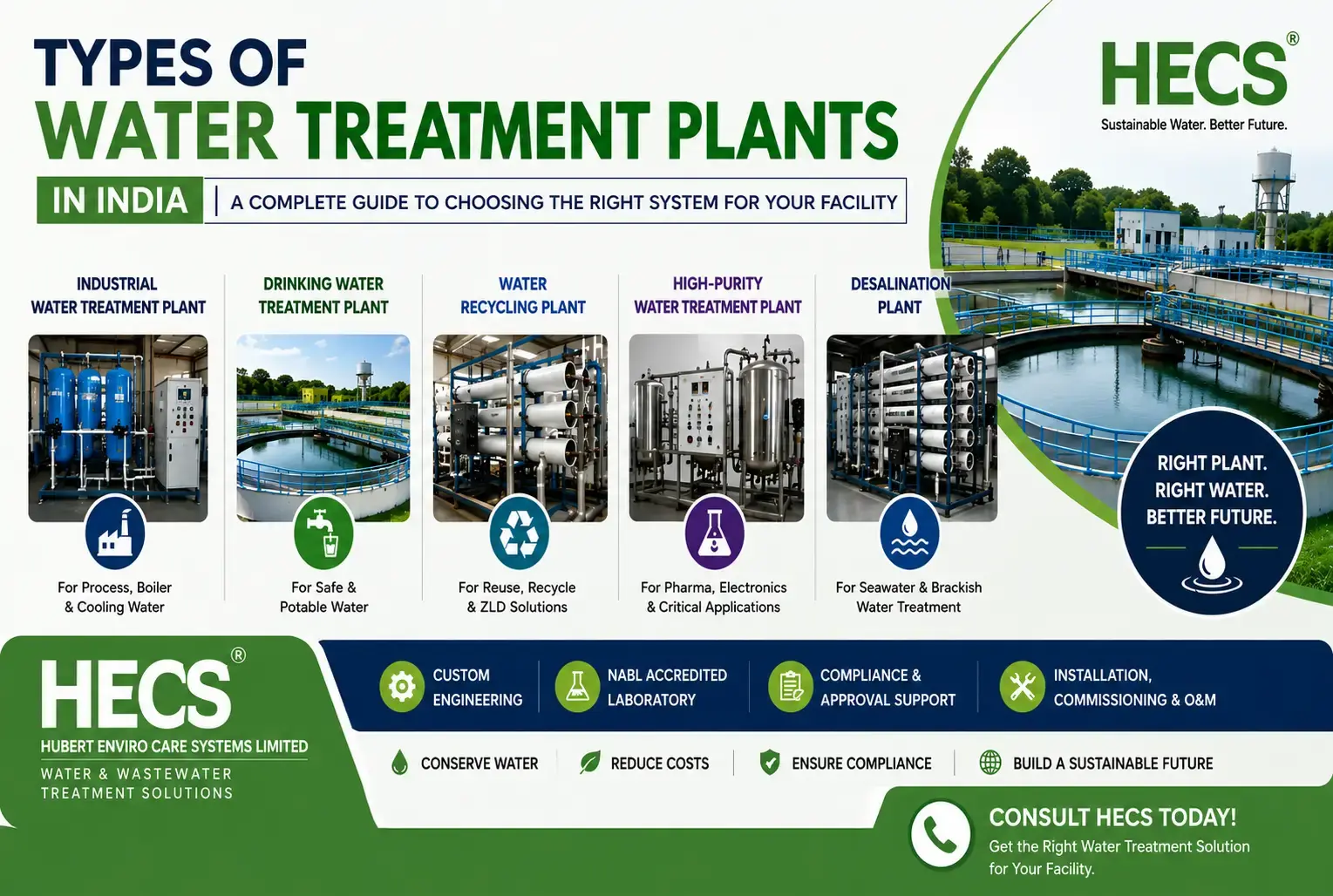
Quick answer: types of water treatment plants in India The five main types of water treatment plants in India are industrial water treatment plants (IWTP), drinking water treatment plants, water recycling plants, high-purity water treatment plants, and desalination plants. The right system depends on your source water, required water quality, application, and regulatory requirements such as SPCB, CGWA, CTE, and CTO approvals.
|
Water treatment is not one-size-fits-all. The system a pharmaceutical unit needs to make injection-grade water has almost nothing in common with what a coastal township needs to turn seawater into drinking supply. Across Indian industry and infrastructure, there are five main types of water treatment plants: industrial water treatment plants, drinking water treatment plants, water recycling plants, high-purity water treatment plants, and desalination plants. Each is built around a different source water, a different end use, and a different set of regulatory conditions. This guide explains what each one does, who it suits, and how to choose the right system for your facility.
Picking the wrong plant is an expensive mistake. An oversized demineralisation stage or an RO train you never needed adds lakhs in capital and running cost. An undersized or ill-matched plant fails a pollution-control inspection or simply can't keep up with demand. So the choice is worth getting right the first time.
1. Industrial Water Treatment Plant (IWTP)
An industrial water treatment plant conditions raw incoming water — from a borewell, river, or municipal line — so it can be used safely in industrial processes such as boiler feed, cooling towers, and production lines. Untreated hard or high-TDS water scales boilers, corrodes piping, and shortens the life of expensive equipment.
A typical treatment train runs clarification, then multigrade sand and activated carbon filtration, then softening or reverse osmosis, and finally demineralisation (DM) where boiler-grade water is required. The exact stages depend entirely on your source water quality and process needs.
Best suited for: manufacturing, textiles, food processing, chemical plants, and power generation.
Learn more: Industrial Water Treatment Plant
2. Drinking Water Treatment Plant
A drinking water treatment plant converts raw surface or groundwater into safe, potable water that meets the Indian drinking water standard, IS 10500:2012. The process usually moves through coagulation, flocculation, sedimentation, filtration, and disinfection by chlorination, UV, or ozonation.
If your source is groundwater, extraction typically needs a No Objection Certificate from the Central Ground Water Authority (CGWA), and potable supply may require local health approvals — factors worth confirming before you design the plant.
Best suited for: residential townships, corporate campuses, educational institutions, hotels, and municipal bodies.
Learn more: Drinking Water Treatment Plant
3. Water Recycling Plant
A water recycling plant treats water that has already been used — usually the treated effluent from a sewage treatment plant (STP) or effluent treatment plant (ETP) — and polishes it to a quality fit for reuse in flushing, gardening, cooling towers, or even back into the process. It commonly adds ultrafiltration and reverse osmosis as a tertiary stage after secondary treatment, and it sits at the heart of any Zero Liquid Discharge (ZLD) system.
The payoff is direct: less freshwater drawn in, less effluent discharged out, easier compliance with State Pollution Control Board reuse conditions, and a lower water bill.
Best suited for: water-stressed industrial zones, IT parks, townships, and any facility operating under a ZLD or reuse mandate.
Learn more: Water Recycling Plant
4. High-Purity Water Treatment Plant
A high-purity water treatment plant produces ultrapure water for applications where even trace ions, organics, or microbes are unacceptable. In pharmaceuticals that means Purified Water and Water for Injection (WFI) to IP and USP standards. In semiconductors and electronics it means ultrapure water approaching a resistivity of 18.2 MΩ·cm. Power plant boilers and NABL testing laboratories have similarly strict needs.
These systems layer reverse osmosis, electrodeionisation (EDI), mixed-bed polishing, and UV or ultrafiltration, with continuous online monitoring to prove the water stays within spec.
Best suited for: pharmaceutical and biotech units, electronics and semiconductor manufacturing, laboratories, and critical process industries.
Learn more: High-Purity Water Treatment Plant
5. Desalination Plant
A desalination plant removes salinity from seawater or brackish water to make it usable. Seawater reverse osmosis (SWRO) is now the standard technology; thermal methods such as multi-stage flash (MSF) and multi-effect distillation (MED) are used in specific large or energy-linked installations. With freshwater scarcity rising along India's coastline, desalination is moving from niche to necessity for many coastal operations.
Best suited for: coastal industries, ports, and regions where conventional freshwater sources fall short.
Learn more: Desalination Plant Solutions
The five types at a glance
Plant type | Primary purpose | Best suited for | Key technologies | Output |
Industrial WTP | Condition raw water for process, boiler and cooling use | Manufacturing, power, textiles, chemicals | Filtration, softening, RO, DM | Process / boiler-grade water |
Drinking Water TP | Produce safe potable water | Townships, campuses, hotels, municipalities | Coagulation, filtration, disinfection | IS 10500 potable water |
Water Recycling | Treat used water for reuse | ZLD sites, IT parks, industry | Ultrafiltration + RO (tertiary) | Reusable non-potable / process water |
High-Purity | Ultrapure, ion-free water | Pharma, electronics, labs | RO + EDI + mixed-bed + UV | Ultrapure / WFI-grade water |
Desalination | Remove salt from sea / brackish water | Coastal industry, ports | SWRO (or thermal MSF / MED) | Fresh water from a saline source |
How to choose the right water treatment plant for your facility
Four questions settle most decisions:
What is your source water?
Municipal, borewell, river, seawater, or recycled effluent — the source sets the entire treatment train. Seawater points to desalination; treated effluent points to recycling.
What is the end use and required quality?
Flushing water and injection-grade water sit at opposite ends of the scale, and the gap between them is what drives your equipment and cost.
What does compliance require?
CTE and CTO conditions, SPCB reuse or ZLD mandates, a CGWA groundwater NOC, and IS 10500 for potable water can all shape the design before engineering even begins.
What is your volume and footprint?
Flow rate in KLD (kilolitres per day) and the space you have available determine plant sizing, layout, and capital outlay.
Frequently asked questions
What is the difference between a water treatment plant and a water recycling plant?
A water treatment plant treats fresh source water to make it usable. A water recycling plant treats water that has already been used — such as STP or ETP effluent — and polishes it for reuse.
2. Do I need CTE, CTO, or any approval to set up a water treatment plant?
It depends on the plant and source. Groundwater extraction generally needs a CGWA NOC, effluent- and discharge-linked systems fall under State Pollution Control Board consents, and potable supply may need a health clearance. An environmental consultant can confirm exactly what applies to your project.
3. Which water treatment plant is best for a pharmaceutical company?
A high-purity water treatment plant, built on RO, EDI, and mixed-bed polishing, to produce Purified Water and Water for Injection that meet IP and USP standards.
4. How much does a water treatment plant cost in India?
Cost is driven mainly by capacity (KLD), source water quality, and the output standard you need to reach. Because these vary widely between facilities, the figure is best answered with a site-specific proposal rather than a generic price.
5. What is Zero Liquid Discharge, and how does it relate to water recycling?
Zero Liquid Discharge means no liquid effluent leaves your site. It is achieved by combining a water recycling plant with evaporation and crystallisation stages so that nearly all water is recovered and reused.
Why choose Hubert Enviro Care Systems Limited (HECS) for water treatment plants in India?
If you are looking for the best water treatment plant company in India, Hubert Enviro Care Systems Limited (HECS) is a trusted name in industrial and commercial water treatment solutions. Hubert Enviro Care Systems Limited (HECS) is one of the leading water treatment plant manufacturers and environmental engineering companies in India, delivering advanced industrial water treatment plants, drinking water treatment plants, water recycling systems, high-purity water treatment plants, and desalination plants.
From water quality testing and custom plant design to turnkey installation, commissioning, operation & maintenance (O&M), and environmental compliance support, Hubert Enviro Care Systems Limited (HECS) provides complete water treatment solutions for industries, commercial facilities, institutions, and infrastructure projects across India.
Whether you need a new water treatment plant, a water recycling system, or a high-purity water treatment solution, HECS delivers reliable, efficient, and cost-effective systems tailored to your facility.
Contact Hubert Enviro Care Systems Limited (HECS) today for a free consultation and get the right water treatment plant solution for your project.
If you are planning a water treatment project anywhere in India, HECS can recommend the most efficient and cost-effective system for your facility


Share this post: