

Sewage Treatment Plant (STP) Annual Maintenance Contracts in India: Cost, Scope & What to Check Before You Sign

Sewage Treatment Plant (STP) Annual Maintenance Contracts
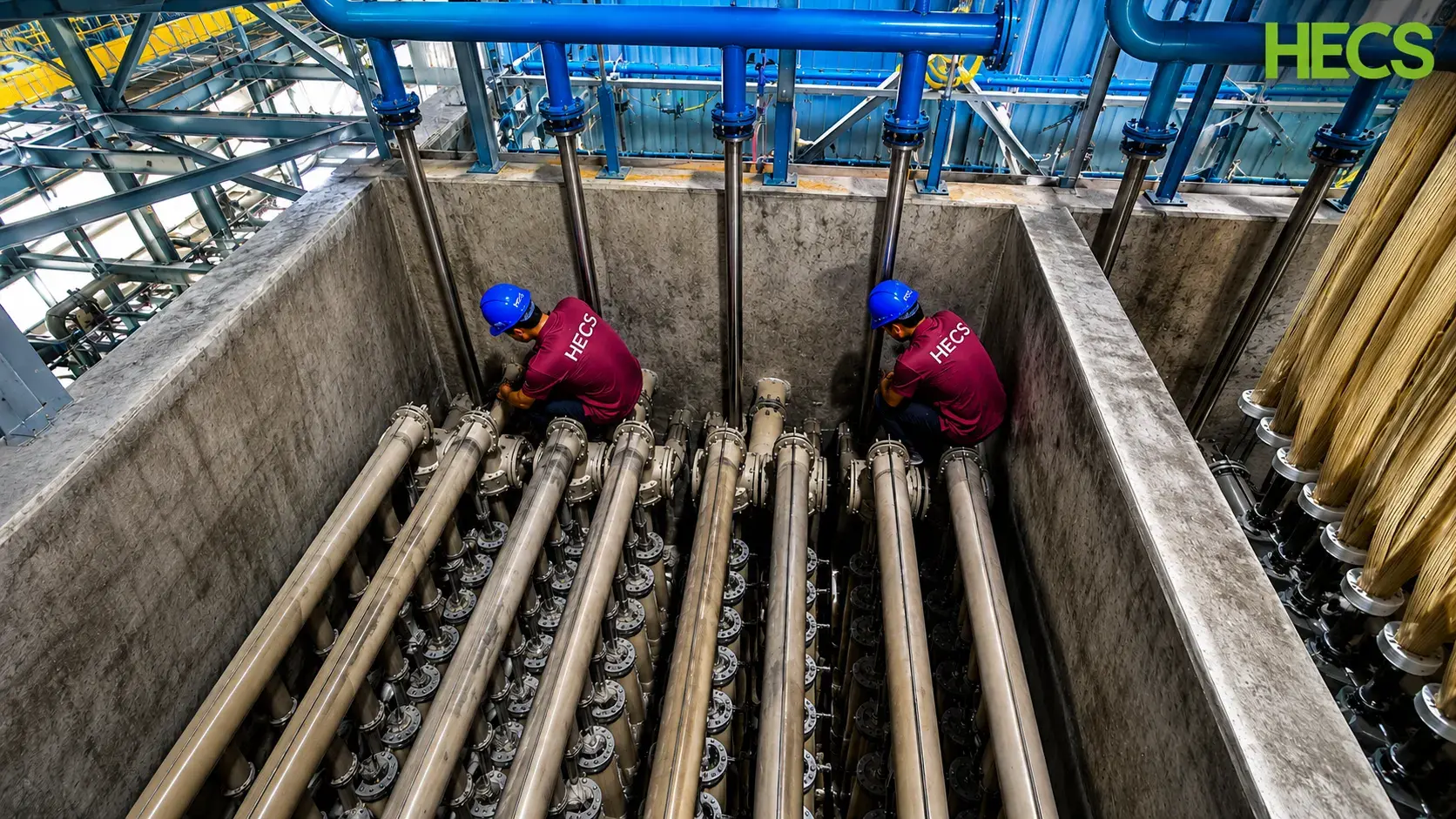
If you own, manage, or are responsible for compliance at a facility with a sewage or effluent treatment plant, you've likely faced this question: should you run the plant with your own team, hand it over under an Annual Maintenance Contract, or go with a full turnkey operator from day one? The answer affects your operating cost, your compliance risk, and how much time your facilities team spends firefighting plant issues instead of running the business.
This guide breaks down what an STP or ETP AMC actually covers, what drives the cost, how it compares to in-house O&M and full turnkey operation, and a checklist to run through before you sign anything.
What Is an STP Annual Maintenance Contract (AMC)?
An STP AMC is a contractual arrangement — usually renewed yearly — where a third-party O&M provider takes responsibility for the day-to-day running and upkeep of a sewage treatment plant. Instead of the facility owner hiring, training, and managing plant operators directly, the AMC vendor deploys trained personnel, manages spares and consumables, and is accountable for plant output meeting discharge or reuse standards.
This model is common across factories, residential townships, IT parks, hospitals, hotels, educational institutions, and municipal infrastructure — anywhere a treatment plant needs to run reliably without the owner building an internal O&M department.
The same logic applies to ETP AMCs for effluent treatment plants, with one key difference: industrial effluent is more variable than domestic sewage, so ETP AMCs usually need a vendor with chemical engineering depth, not just plant operation experience.
Why Industries, Institutions & ULBs Choose an AMC Over Running It Themselves
Three reasons come up repeatedly when facility owners explain why they moved to an AMC model:
Compliance risk - A poorly run STP or ETP can quickly put you out of compliance with CPCB or State Pollution Control Board (SPCB/TNPCB) discharge norms. An experienced AMC vendor builds compliance monitoring into daily operation rather than treating it as a once-a-quarter scramble.
Predictable cost vs. unpredictable downtime - Plant breakdowns rarely happen on schedule. An AMC converts unpredictable repair costs and emergency call-out charges into a known annual number — particularly with a comprehensive contract.
Access to trained operators without building a department - Skilled STP/ETP operators — especially those experienced with MBBR, MBR, SBR systems — are not easy to hire and retain directly, especially outside major cities. An AMC vendor already has this bench strength.
For Urban Local Bodies (ULBs) and PPP-based sewage infrastructure projects specifically, AMC arrangements also solve a staffing problem that's structural rather than situational: municipal bodies are rarely equipped to run 24x7 sewage pumping stations and decentralised STPs with their own staff, which is why AMC and O&M contracts for ULB and PPP sewage infrastructure are tendered out almost as standard practice.
What Does an STP AMC Typically Include?
Scope varies by vendor and contract type, but a well-structured STP or ETP AMC generally covers the following:
Daily Operation & Monitoring
Round-the-clock or shift-based plant operation depending on capacity and criticality
Monitoring of flow, dissolved oxygen, pH, and other process parameters
Sludge management and disposal coordination
Preventive Maintenance
Scheduled servicing of pumps, blowers, aerators, and diffusers
Cleaning and inspection of tanks, screens, and filters
Calibration of instrumentation and dosing systems
Breakdown & Emergency Support
Defined response-time SLA for equipment failure or process upset
Standby equipment or rental arrangements for critical failures, where included
Compliance & Reporting
Periodic treated water testing against CPCB/SPCB discharge or reuse norms
Support with consent-to-operate renewals and statutory documentation
Monthly or quarterly performance reports for management and regulators
Spares, Chemicals & Consumables
Dosing chemicals for coagulation, disinfection, or pH correction
Wear-and-tear spares — covered fully, partially, or billed separately depending on contract type
Manpower Deployment
Certified plant operators and supervisors, deployed on-site or visiting as per schedule
Backup staffing to cover leave, absenteeism, and shift gaps
STP & ETP AMC Cost in India: What Determines the Price
There's no single "AMC rate card" that applies across India — a combination of factors specific to your plant drives pricing. The ranges below are indicative and meant to help you sanity-check a quotation, not replace one.
Factor | Why It Moves the Price |
Plant capacity (KLD) | Larger plants need more manpower hours, more chemicals, and bigger spares — cost scales with capacity, though not always linearly. |
Treatment technology | MBR and MBBR systems generally cost more to maintain than conventional ASP systems due to membrane care and aeration intensity. |
Comprehensive vs. non-comprehensive scope | Comprehensive AMCs (spares + labour included) cost more upfront but reduce surprise expenses through the year. |
Manpower deployment model | Full-time on-site staff costs more than a visiting-technician model with remote monitoring. |
Plant age & condition | Older or poorly maintained plants often need a higher AMC quote in year one to bring equipment back to a stable baseline. |
Compliance testing frequency | More frequent lab testing for discharge parameters adds to the annual cost but reduces compliance risk. |
Location | Remote sites with limited access to spares or skilled technicians typically carry a logistics premium. |
Indicative annual cost bands by capacity (broad ranges only — always confirm with a site-specific quote):
Plant Capacity | Typical AMC Scope | Indicative Annual Cost Range* |
Up to 50 KLD | Part-time/visiting operator, basic preventive maintenance | Lower range — a few lakh rupees per year |
50–200 KLD | Dedicated operator(s), regular preventive maintenance, periodic testing | Moderate range — scales with manpower and testing frequency |
200–500 KLD | Shift-based staffing, comprehensive spares coverage, monthly compliance reporting | Higher range — driven mainly by manpower and spares scope |
500 KLD and above | 24x7 staffing, full comprehensive coverage, dedicated supervisor | Significantly higher — site-specific quote essential |
*Indicative only. Actual cost depends on technology, location, scope, and contract terms. Request a site visit and custom quote for an accurate number.
In-House O&M vs. AMC vs. Full Turnkey O&M: Which Is Right for You?
Aspect | In-House O&M | AMC (Third-Party) | Full Turnkey O&M |
Staffing | You hire, train & retain operators | Vendor deploys trained staff | Vendor staffs from project start |
Cost predictability | Variable — depends on internal efficiency | High, especially with comprehensive scope | High, often bundled into long-term contract |
Compliance accountability | Fully on the owner | Shared — vendor supports reporting, owner retains responsibility | Largely with the vendor under contract terms |
Technical expertise access | Limited to what you hire | Vendor's full bench strength across technologies | Vendor's full bench strength, integrated from design stage |
Capital investment | Higher — spares inventory, tools, training | Lower — bundled into AMC fee | Often bundled into the original project cost |
Best suited for | Large sites with dedicated technical teams already in place | Existing plants needing reliable, cost-predictable maintenance | New projects where design, build, and long-term operation sit with one partner |
STP AMC vs. ETP AMC: Key Differences
While the AMC structure is similar, the technical demands differ:
Effluent variability: Industrial effluent composition can change with production schedules, raw materials, and process changes — ETP AMC teams need to adjust dosing and monitoring accordingly, while domestic sewage in an STP is relatively predictable.
Chemical handling: ETP AMCs often involve more intensive chemical dosing (coagulants, neutralising agents) and require operators comfortable with industrial chemical safety protocols.
Equipment wear: Corrosive or high-TDS effluent accelerates equipment wear, so ETP AMC scopes often build in more frequent equipment inspection than a comparable STP.
Discharge parameters: ETPs are typically held to industry-specific discharge standards set by CPCB/SPCB for that sector, which the AMC vendor needs to be familiar with — not just generic sewage norms.
AMC for Sewage Pumping Stations Under PPP & ULB Arrangements
Municipal sewage infrastructure — pumping stations, decentralised STPs, and citywide sewerage networks — increasingly runs on PPP (Public-Private Partnership) or ULB-tendered O&M arrangements rather than direct government operation. If you're a municipal engineer, consultant, or PPP project authority evaluating vendors for this kind of contract, the evaluation criteria shift slightly from a typical industrial AMC:
Tendering and statutory experience: Vendors need a track record of working within government tendering frameworks, including documentation, audits, and reporting formats ULBs require.
24x7 criticality: Sewage pumping stations can't go offline — AMC vendors for this segment need genuine round-the-clock staffing capability, not just a callout arrangement.
Multi-site management: Many ULB and PPP contracts cover several pumping stations or decentralised plants under one contract, requiring a vendor with the manpower depth to manage multiple sites consistently.
Long-term reliability: PPP contracts often run for several years, so financial stability and project history matter as much as technical capability.
HECS has supported municipal and decentralised sewage infrastructure projects, including packaged STP installations for state and municipal bodies, and brings this experience into how AMC contracts for ULB and PPP infrastructure are scoped and staffed.
10-Point Checklist: What to Check Before You Sign an STP or ETP AMC
Scope type: Is this comprehensive (parts + labour + consumables) or non-comprehensive (labour only)? Get it in writing, not implied.
Manpower qualifications: Ask for the certifications and experience of the operators who will actually be deployed at your site — not just the vendor's general capability.
Response-time SLA: Get a written maximum response time for breakdowns, with a penalty clause if it's missed.
Spares & consumables list: Get an explicit list of what's included in the AMC fee and what gets billed separately.
Compliance reporting support: Confirm whether consent renewals, treated water testing, and statutory reporting are part of the scope or an add-on.
Technology familiarity: Ask whether the vendor has hands-on experience with your specific treatment technology — MBBR, MBR, SBR or otherwise.
Insurance & liability: Confirm the vendor carries liability insurance for personnel and equipment while on your premises.
Reference sites: Ask for at least two reference sites of comparable capacity and technology currently under the vendor's AMC.
Pricing structure: Understand whether the price is fixed for the term or subject to escalation, and what triggers a revision.
Exit & handover terms: Clarify the notice period and handover process if either party wants to exit before renewal.
Common Mistakes to Avoid When Selecting an AMC Vendor
Choosing on price alone - The cheapest AMC quote is often non-comprehensive with a thin spares list — the real cost shows up mid-year as “extras.”
Not verifying technology-specific experience - A vendor strong in conventional ASP systems may not be the right fit for an MBR- or ZLD-linked plant.
Skipping the SLA conversation- Verbal assurances on response time don't hold up during an actual breakdown — get it written into the contract.
Ignoring compliance support - If the AMC doesn't explicitly cover testing and reporting support, you may end up managing CPCB/SPCB compliance separately and losing the main benefit of outsourcing.
No exit clause review - Plants change hands, contracts get re-tendered — make sure transition terms are clear from day one.
Why Facilities Across India Choose HECS for STP & ETP AMC
With over 28 years of experience in environmental management, Hubert Enviro Care Systems (HECS) has established itself as one of the leading STP AMC companies in India and a trusted ETP maintenance company in India. Our dedicated Operations & Maintenance division is among the country's largest third-party providers for STP and ETP Annual Maintenance Contracts (AMC), helping industries, commercial facilities, institutions, and municipalities achieve reliable plant performance and regulatory compliance.
A few factors that define how we deliver our AMC services:
Integrated Environmental Services
Unlike standalone maintenance providers, Hubert Enviro Care Systems (HECS) combines turnkey design and installation, STP & ETP operation and maintenance, NABL-accredited laboratory testing, regulatory consultancy, plant audits, and modernisation services under one organization. This integrated approach ensures your AMC supports long-term plant efficiency, compliance, and future upgrades.
Expertise Across Multiple Treatment Technologies
Recognized by many clients as one of the best STP maintenance companies in India, HECS has extensive experience operating and maintaining conventional and advanced wastewater treatment technologies, including MBBR, MBR, SBR, ASP, packaged STPs, industrial ETPs, tertiary treatment systems, and water recycling plants. We also manufacture packaged sewage treatment plants, enabling faster technical support and genuine replacement solutions.
Pan-India Operations & Support
Our team of 2000+ environmental professionals supports facilities across India, delivering STP AMC services, ETP AMC services, preventive maintenance, troubleshooting, and process optimization for industrial, commercial, institutional, healthcare, hospitality, residential, and municipal infrastructure projects.
Compliance-Driven Plant Management
As a trusted STP operation and maintenance company in India and ETP O&M service provider, HECS structures every AMC around regulatory compliance. Daily plant operation, monitoring, documentation, laboratory coordination, and reporting are aligned with CPCB, SPCB, TNPCB, and other applicable regulatory requirements, helping clients maintain consistent treated water quality and reduce compliance risks.
Get a Site-Specific STP & ETP AMC Quote
Tell us your plant capacity, treatment technology, industry, and current operational challenges. Our experienced O&M team will evaluate your requirements and provide a customized STP/ETP Annual Maintenance Contract (AMC) proposal with a detailed service scope.
Share this post: